
A blend of experimentalism and homage
A music without borders
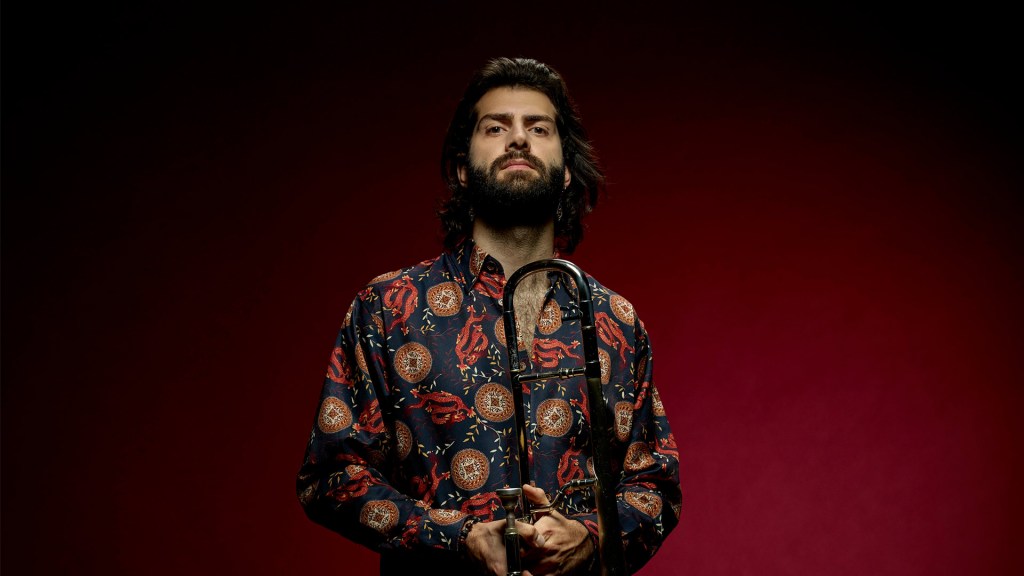
The artist Robinson Khoury is back with his third album MŸA, an experimental opus mixing traditional and electronic music.
Who is Robinson Khoury?
Khoury, born in 1995 in a musician family, takes interest in music at a young age. Quickly, he builds a prestigious reputation working with musicians such as Ibrahim Maalouf, Quincy Jones and the music ensembles SARĀB and Metropole Orkest. After several years of performing with the group Uptake, Khoury releases his first solo album, Frame of Mind in 2019. Even if Robinson Khoury is more known as a trombonist, he is also a multi-instrumentist (synthesizers, winds) and singer.
What is MŸA?
MŸA, with oriental and futuristic colors, transports us in a world where experience is at the centre, whether if it’s musical or human. Inspired by ancient melodies, Arabic music and skin rhythms, Khoury takes us to the universe of creation.
“[MŸA is a] personal vision of the goddess of creation, without being assimilated to a specific universe” — Robinson Khoury
First track of the album, Cosmos highlights Khoury’s virtuosity. From our first listen, we can hear the influence of Arabic music, by the use of quarter tones on the trombone and the rhythm played on the percussions, typical of skin rhythms.
Quelque chose bouge is a track full of theatricality, where Khoury declaims a text accompanied by a minimalist instrumental (strings and piano). Little by little, the artist’s voice deforms, giving room to a deconstruction of speech, reducing it to a “simple” sound. True metaphor of chaos and creation, we enter into the universe more experimental of this album.
QĀNĀ (“create/receive” in Biblical Hebrew), welcoming the Syrian singer Lynn Adib as a feature artist, is a fusion between Arabic music and jazz. Quickly, a dialogue takes place between Khoury and Adib, alterning the two musical genres (obtained by the vocals and scat of Adib). Those characteristics are found again in BIRTH OF NOHAM and AGES (which also have a more pop sound).
Ondes et variations is a minimalist song, highlighting repetitive music. Khoury, at the trombone, opens the track alone, playing on resonance, phrasing and intonation. Gradually, we have a superposition of synthesizers. Rapidly, the second synthesizer who plays a drone note modulates, creating an illusion of a sound wave. This same illusion is repeated at the end of the track, with the totality of the synthesizers.
ARAZU, the track concluding this opus, invites Natacha Atlas, a Belgian singer with Egyptian-English origins. This song, with heavy influences from Arabic music by the use of quarter tones on the trombone and melismas in the singing, has the same structure as QĀNĀ, Khoury and Atlas creating a dialogue.
MŸA is an album filled of experimentations, opening us to a musical universe without borders.
Photo © Alexandre Lacombe




 The Musician Insight
Leave a comment