
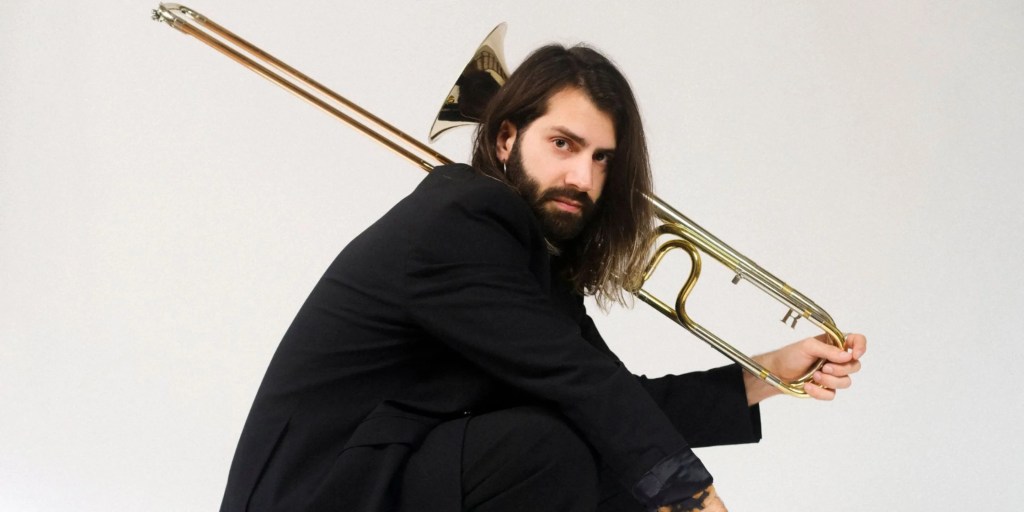
L. Park: Your latest album, MŸA, is the perfect blend of Arabic music, jazz and electronic music. How did you approach this vision of music as a musician and composer?
Robinson Khoury: Thank you, first of all, “perfect approach”, I like this term. I always try to not think about “I want to mix this and this”, it appears naturally when I work on the music, while composing. I think I didn’t really work so much on Arabic music for this album, but since I learned a bit of Arabic music and played it also with Arabic musicians, then it’s really into my sound. So when I’m writing, we can of course hear those musical influences, and especially in this project MŸA because it’s modal music.
So, I wanted to play electronic music with my modular synthesizer for this album.
And of course, with the modular synthesizer, we have sequences, we have repetitive stuff. So I wanted really to go deep into modal music, which is the same case with Arabic music when you are playing it: one song is only in one mode, called Māquam.
So yeah, I’m not really thinking about mixing this and this, but more like it appears naturally, like “I wish to express this”. As an album, it was the moment to go into modal music, to process with the electronic, the voice, the percussions, the acoustic and mixing it with the electronic. So, I wanted something really original, really unique in that way.
And the result is the birth of this album.
L. Park: How did you learn Arabic music?
Robinson Khoury: When I was eighteen, I started to research about Arabic music for my memoir when I was studying in the National Superior Conservatory in Lyon. I wanted to approach the study of learning Arabic music as an occidental background, musically.
The second point was how to adapt it with my instrument (the trombone), which is not an Arabic one, to this music. And it appears that this process was very natural, because the trombone is very close to the voice — which is why I chose it as my instrument.
Because when I was young, and my voice began to change, I needed to find something else in order to express myself. So I began with the trombone, as for me, it was the best way to sing in an instrument.
And yeah, there were many similar techniques on voice and trombone, like the glissando, the ornementations… In Arabic music there’s a lot of these, so it felt like it was a perfect fit, and I suppose that to be able to do that with my trombone, it’s kind of magical.
L. Park: Which track was the most challenging for you to write and why?
Robinson Khoury: Hmm, I don’t know, because when you write something, it’s not really challenging. For me, it’s more when you need to play it: it’s not the idea that is complex, it’s its execution.
I would say that MŸA was the most complicated track to play, because it’s a lot of different moods together: energetic with percussions, synthesizer, voices with the piano… And then, again, there’s a lot of electronic stuff that we had to blend together, so yeah, MŸA was definitely the hardest to play.
To write, I would say Horizon, because we had to change a lot of things: I wasn’t happy with the first version. So we re-wrote it a lot, and even now during the concerts, we always perform a different version than the one from the album… So I would advise you to come to see us live!
L. Park: What didn’t you like when you wrote Horizon, why did you choose to change?
Robinson Khoury: I don’t know, sometimes you have a strong feeling when you compose, while being in a certain mood, and when you go back to it, you lost all track of what feeling you wished to convey. I remember that when I wrote Horizon, I was in a kind of retreat: I rented a house in the countryside to really focus on composing. So I was truly alone with my music, which was a completely different feeling than playing it with two other people. So in a lot of compositions, I had to adapt things but with Horizon, it was more than with the others.

L. Park: Quelque chose bouge touches upon the subject of creation and chaos through the deconstruction of the voice. What was your creative process to express such a complex matter?
Robinson Khoury: Quelque chose bouge is a new musical path that I’m taking. It was really a gamble, a challenge to do it. I never spoke on a track before, but when I wrote this poem — in the same country house — I was reading Aurélien Barrault, an astrophysicist. Therefore, I wanted something kind of abstract, but with two meanings: creation, Earth, cellular and how things are moving inside of you when you compose. It’s like giving birth — a bit like all creations.
Then I put the recording of this poem into my sampler, in my modular synthesizer, and I really deconstructed it. I fell in love with the sound it was producing, and then we just decided to keep it on the album (and even for the live performances). It can be a bit weird for the audience, as it’s disconnected from the rest of the show, but it’s really interesting in a way.
L. Park: Repetitive music is highly present, especially in MŸA, can you tell us who were your inspirations?
Robinson Khoury: there were many inspirations, of course, Steve Reich, master of repetitive music and minimalism. American music, but also more modern electronic composers like Floating Points, Fortet, Nils Fram, all these waves of electronic music. But there’s also Radio Head: they use a lot of repetitive patterns and synthesizer and I also have to name this band in Paris that I love, Cabaret Contemporain. They are great friends and they all play repetitive music just with acoustic instruments. There is also the trance aspect of it, because for me, modal music is really connected to ancient music, so repetitive music is highly related to the transe.
L. Park: Onde and Variations is a masterpiece of modern impressionism, how did you first envision this track?
Robinson Khoury: It’s funny because it’s an improvisation, and it’s the only fully improvised track on this opus. It happened when I was in the studio, and first of all, we were supposed to record an EP of like five tracks. Then I came out with Onde and Variations, which is just me, my modular synthesizer and my trombone. As you can imagine, it was very challenging to record: I had to manage to play and then hit the buttons, on and on. After, I remember Antoine Rajon from the label said: “let’s keep it on the album” and Félix (our sound engineer) really loved this track. So Onde and Variations was a bit of a surprise for us all.
L. Park: You invited Lynn Adib and Natacha Atlas to perform with you on this opus. How was it for you to work with them?
Robinson Khoury: I’ve known Natasha for a while now, almost ten years: we played together with Ibrahim Maalouf in Jazz à Vienne in 2015. Then I recorded on two of her albums, Myriad Roads and Strange Days and I always thought of inviting her on this album. It was a good context and I’m really proud and glad that Natasha’s sung on it. Arazu is one of the most beautiful tracks on this record.
Lynn was also a sort of a surprise because we met just a couple of months before recording. It was during a part organized by a collective in Paris, with the goal of mixing artists.
So we were three musicians together with the percussionist Najib, and we met by playing music. It was so magical that we felt like we should play together more and I proposed to Lynn to record on the album and she accepted. Since then she performed with us two times, in Jazz sous les Pommiers and then in Café de la Danse and it was amazing! I think that we will continue to play together…
L. Park: You’ve broke down many barriers and fixed ideas on the trombone and music in general. What is your next step?
Robinson Khoury: The next step will be, for my next album in maybe two years, to create a new quartet. The goal would be to infuse some bits of classical, jazz and improvised music with acoustic instruments like the cello, the double bass, the piano, etc.
I also wish to explore more the writing of ancient music and baroque music: I would love to create a blend of baroque and Arabic music, a bit more near the classical stuff, like chamber music.
The other project I have in mind would be a big ensemble with seven or eight people, with vocals, strings, electronic and chamber music blended. So I always wish to explore and do more!
Photo source: http://www.ronniescotts.co.uk




 The Musician Insight
Leave a comment