
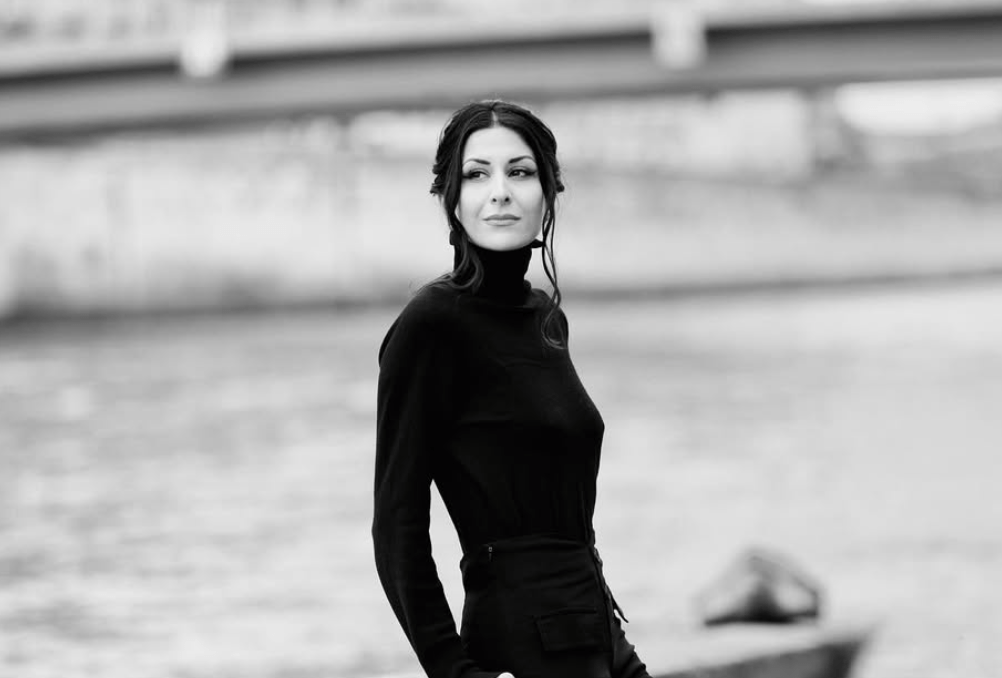
L. Park: Your new album is titled In Vino Veritas, meaning (in a literal sense) “in wine, lies the truth.” What does this expression mean to you, and how does it relate to the themes of the album?
Anousha Nazari: For me the proverb evokes the moment when every mask falls away and only sincerity remains. In Vino Veritas is therefore the perfect motto for an album that celebrates Omar Khayyam, the poet who praised wine, love and the fleeting “now.”
We invited four classical contemporary Iranian composers to compose new works, each for mezzo‑soprano, clarinet and piano, on a quatrain of Khayyam they felt drawn to. Their individual styles offer four reflections of the same crystal, allowing the listener to taste the truth that shimmers in his verses.
L. Park: This opus is an homage to the great poet Omar Khayyam. Why was it so important for you to highlight his poetry?
Anousha Nazari: Khayyam is far more than the carefree epicure some imagine. He was also a philosopher, mathematician and astronomer who designed a remarkably precise solar calendar. His quatrains reveal a lucid mind fascinated by the brevity of life and the wonder of the present instant. Giving voice to those lines felt essential: his thoughts remain strikingly relevant, and I wished to draw attention to that timeless clarity.
L. Park: In tracks like Hich and Hast o Nist, we hear contemporary and jazz influences, particularly in the piano chords and clarinet technique. Which artists have most inspired you in shaping this sound?
Anousha Nazari: Those two pieces were composed for the album by Basir Faghih Nasiri. Any jazz colour you perceive springs from his own musical imagination; it would be presumptuous for me to name the sources of his inspiration. As performer, my task was simply to inhabit the language he offered and allow his harmonic world to unfold naturally. I love the freshness and energy he brought to these four miniatures.
L. Park: What was it like working with composers such as Rouzbeh Rafie and Basir Faghih Nasiri? Can you tell us more about the creative process behind those collaborations?
Anousha Nazari: We began by immersing ourselves in Khayyam’s quatrains and choosing the poems that resonated most deeply with each composer. Aso Kohzadi, Rouzbeh Rafie, Basir Faghih Nasiri and Mehdi Panahi then wrote works specifically for me (mezzo-soprano), clarinet (Amin Ebrahimi) and piano (Laurianne Corneille).
Throughout, we exchanged ideas, worked on range, articulation and texture until the music felt tailor‑made. The process was rigorous and occasionally frustrating, but very enriching; everyone had a distinct sensibility, yet all remained united by Khayyam’s spirit.
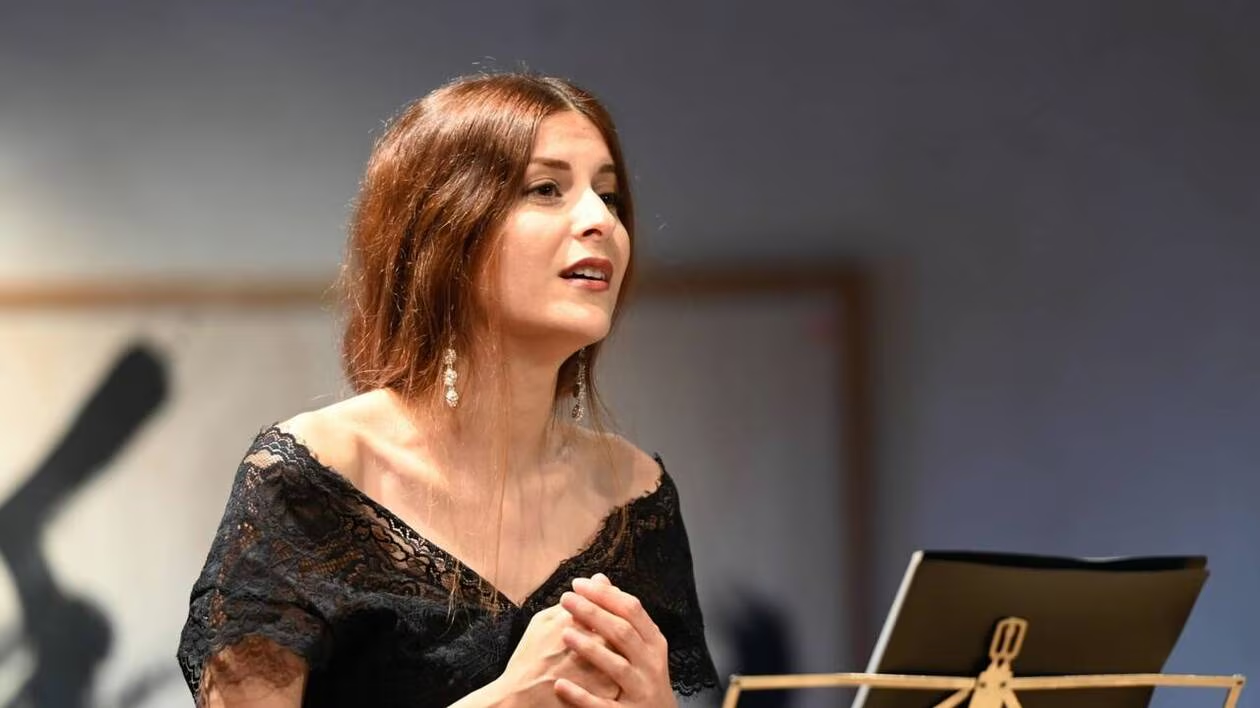
L. Park: Last Night at the Ceramic Artist’s Studio is perhaps the darkest piece on the album. In it, we hear your incredible vocal range and theatricality. Which song was the most challenging to interpret, and why?
Anousha Nazari: Rafie’s score is highly demanding, requiring swift shifts of colour and dynamics, yet I would hesitate to single out one work as the most difficult. Each composition has its own challenges — whether rhythmic intricacy, extended vocal technique, or subtle microtonal inflection. Confronting those different hurdles was part of the album’s artistic excitement.
L. Park: In the beautiful track Mey‑e Nab, we clearly hear elements of classical and traditional vocal techniques. How do you blend these styles while staying true to your artistic identity?
Anousha Nazari: I was trained in Western classical singing, but Persian ornamentation is part of my musical DNA. Rather than forcing the two traditions together, I let them meet where the text demands it: a bel‑canto line may carry a gentle Persian inflection, while a traditional tahrir may be tempered by classical breath control. My guiding principle is always fidelity to the poem’s meaning and to the musical integrity.
L. Park: Which concert memory do you still hold dear today?
Avishai Cohen: Oh man, that’s like… I mean, I remember some concerts we were playing with Chick Corea that were great. I remember one in particular that I played in the Victoria Jazz Festival with Chick Corea and Jeff Ballard was playing drums and Paco de Lucía was playing with us on that night. It was very memorable for me because he’s one of my idols, heroes or whatever. I admire him very much and got to play with him and to know him, so that’s very memorable.
L. Park: Finally, which of Omar Khayyam’s poems is your personal favorite — and do you have any new projects on the horizon?
Choosing a single quatrain is almost impossible; I cherish above all the overall vision that urges us to seize the present moment. Concerning future work, I am preparing a programme devoted to twentieth‑century Persian art‑songs — an area that aligns with both my speciality and my passion. I will keep the details confidential for now, so that the surprise may be complete when the time comes.
Photo © Jesús Cornejo





 The Musician Insight
Leave a comment