
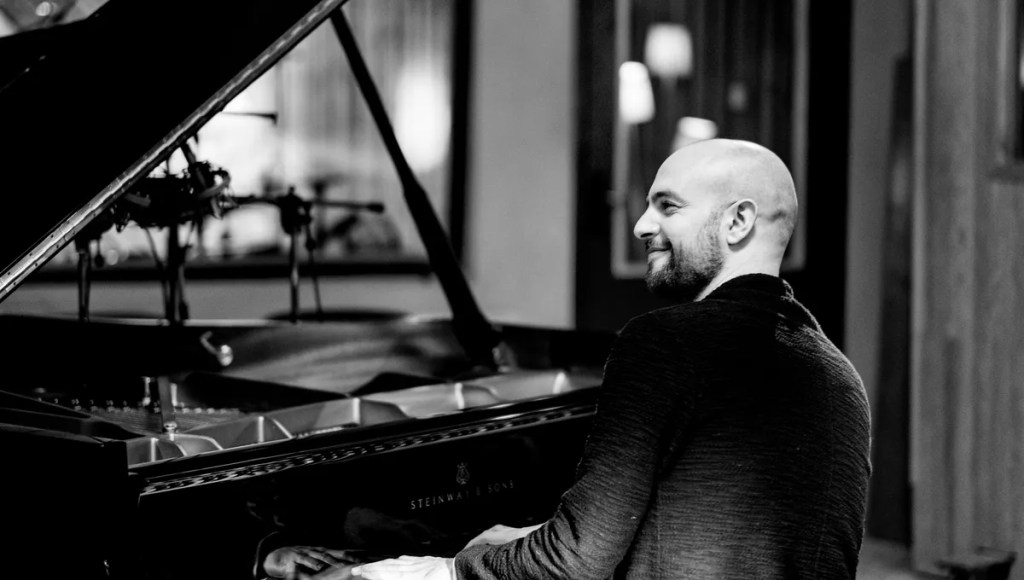
L. Park: Repetitive music is at the center of your new album, Solo: miniatures and tales. What is your process when composing in this genre, and how do you blend it so effortlessly with jazz?
Shai Maestro: My main influence for this kind of music is Steve Reich.
I listen to him quite a lot. And the first track of my album, called Three Colors, is completely improvised, so it just happened naturally.
L. Park: Throughout the album, harmonies play a prominent role. How do you work with them to create such a distinctive sonic experience?
Shai Maestro: There are many, many different ways to talk about harmony. I explore different avenues. Sometimes it’s with a harmony that’s very simple, like folklore harmony that’s built around triads mainly.
Now and then, it’s extended to modern classical harmony. I think if you learn those things, if you learn to control them, then this kind of minimalist approach will come out naturally without me thinking too much about which technique I’m using.
L.Park: Improvisation is a big part of your music, could you walk us through your process?
Shai Maestro: That’s a very wide question, but I’ll share a bit of my perspective. Improvisation, when done well, is almost a late stage of musical development — it relies on a deep understanding of the fundamentals. You need to learn the rules before you can break them. I try to stay respectful to the languages that formed me — jazz and classical — and let them inform my improvisations. From there, I look for my own voice: small sounds, gestures, and ways of approaching music that feel personal.
L. Park: Which of the artists you’ve collaborated with have influenced you the most as a musician and why?
Shai Maestro: Everybody, really: everybody that I play with in my band, the time I spent with Ari Honig, who is a drummer that I love to play with, when I performed with Avishai Cohen, or with classical musicians.
So in some way, every encounter leaves a mark.
L. Park: How did they influenced you?
Sometimes it’s conscious of seeing how a person runs a soundcheck, or how a person deals with harmony. But sometimes it’s really just like you share the energy with the person. You see how the person relates to music and to the passion. So that kind of stuff is not quantifiable.
L. Park: Your musical journey began with classical music. How has it influenced your vision and approach to music?
Shai Maestro: Classical music is the basic DNA building blocks to my music, specifically Bach‘s music. That’s where I learned how to deal with counterpoint, with long forms of composition, with learning how to craft a melody, with learning how to emphasize different voices within one big blur of sound.
And then later on, Debussy, Ravel, this kind of music, this other way of playing the piano, thinking about colors rather than melodies and strict notes.
L.Park: Did the composition workflow for this new album differ in any way from your
previous projects?
Shai Maestro: The process for this album was completely different from anything I’d done before. It involved music production, sound design, and many collaborations — some recorded together in the same room, others remotely. It was a large-scale project that required careful planning but also the ability to stay open to the moment once we were in the studio. It was a fascinating process that taught me a lot about balance between structure and spontaneity.
L. Park: Which musical piece is the most challenging to perform for you and why?
Shai Maestro: It depends. Sometimes the challenges could be technical and other times it can be because it’s different technically. But if a song is very slow, that can be also very difficult. So you need to learn how to control your breath, and to be patient, and to not impose your anxiety on the music. So that’s very difficult as well: I would say there are different sides of difficulty.
L.Park: Speaking of performing, how different is the gear you use on stage compared to in the studio?
Shai Maestro: For now, I mostly play acoustic piano. But for the new project, the setup will evolve: I’ll be using electronics — Ableton Push 3, a small mixer, and some keyboards — to explore new textures and layers. It’ll be a completely different world from my usual acoustic setup.
L. Park: Could you tell us a bit about your overall composing process? Where do you usually start: from an idea, an image, a sound?
Shai Maestro: Yeah. So in everything other than composition, I’m very methodical, very systematic. When I work on ear training, I have a system. If I want to work on this, I have a system, everything is very organized. With composition, I have no idea: every time it’s very different.
It could be like a rhythm motif, it could be like some harmony that I have in mind, a conversation that I have with a person, an image, a texture, a smell. It’s really open.
L. Park: You’ve released and worked on so many projects, which one taught you the
most as an artist?
Shai Maestro: Every project teaches me something different — about music and about myself. Playing solo piano requires one set of tools, while working with a band demands a completely different mindset. I try to stay loyal to each project’s world and remain as open as possible. So, I can’t really choose one that taught me the most; they all shape me in their own ways.
L.Park: How does your process differ when you’re working alone versus with other
musicians?
Shai Maestro: When I work with other musicians, I first try to explain my vision as clearly as possible. But once I feel they’ve understood it, I tell them to forget everything I just said and make the music their own. Otherwise, I’d just be hiring robots to play notes.
I want to be surprised — to hear their colors, instincts, and interpretations. My goal is to stay flexible while maintaining the core of the vision.
L. Park: Finally, what is one piece or project you hope to compose in the future?
Shai Maestro: Simple lyrics and songs, played in a very simple way. It’s a different degree of difficulty. Because I wrote a project for an orchestra, for a philharmonic orchestra, super challenging.
I spent eight months doing it, and it’s like an immense challenge, but it’s a different type of challenge. But if you listen to people like The Beatles, or people like Sufjan Stevens, Nick Drake, people who write a song, that’s very difficult to do it well.
Because you’re dealing with simple ingredients.
Photo © Caterina di Perri / ECM





 The Musician Insight
Leave a comment