
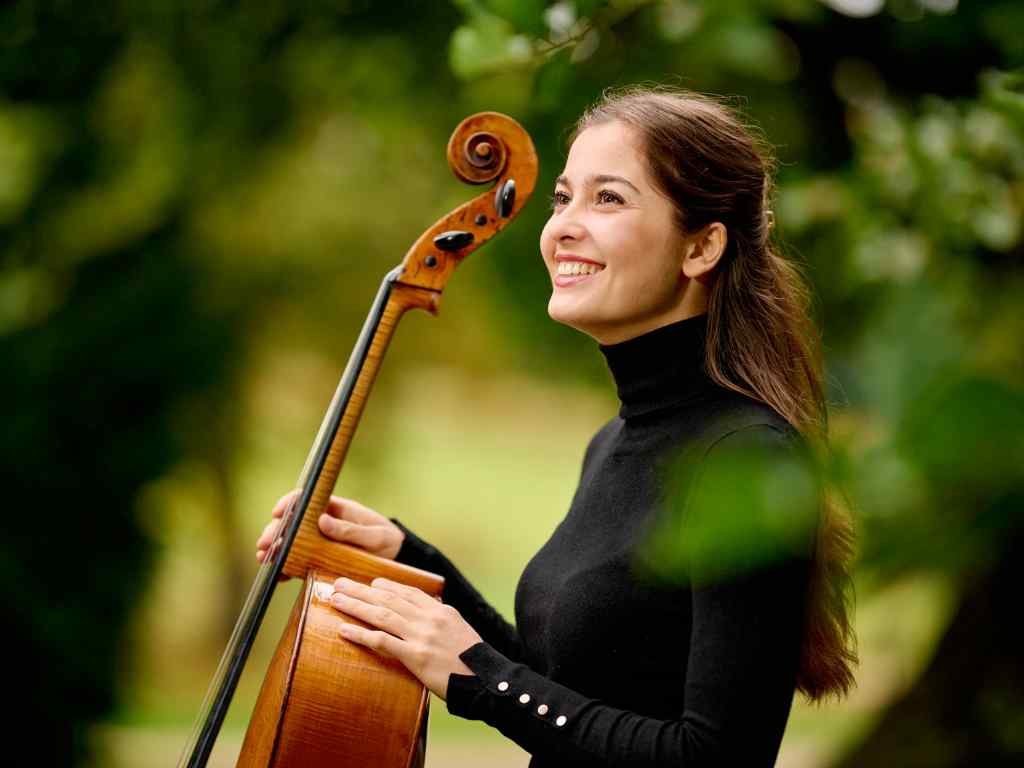
L.Park: Can you tell us a little bit about the history of the cello?
Annabel Hauk: The cello is an instrument that was built and developed around the 17th century in North Italy, and it’s part of the string family with the violin, the viola da gamba, the viola, and the double bass. The developing of the old instruments started around 1650, and these are still sometimes really big. As for the shape we have nowadays — on which we mostly play — it was only developed in the beginning of the 18th century.
So, for example, the cello I’m playing — which is probably from Grangino — was cut later, so its shape is anchored in the one from that period.
Another thing that changed is that, in the beginning, it was played also in processions: meaning that you can see on the back sometimes a little dot with an extra piece of wood. This meant that they probably had the cello around their necks to be able to walk and play at the same time. Later, it was developed for the cellists to have the ability to sit down and an end pin was also added, for example, the baroque cello — which has gut strings because back then the strings were made out of gut — didn’t have an end pin, and the baroque bow also changed its shape. Thus, during this time, it was mostly played in chambers or in smaller venues compared to the concert halls we have today (with thousands of people). Because to perform in bigger spaces, you need more tension from the instrument: so you need to change the physics of the instrument. For example, the bow — which was straight — is now is a little bit convex in order to create more tension on the bow hair (made of horses’ hair). So yeah, these are mostly the features, that I would say that have developed throughout the centuries. And since 250 years, we have only one type of cello from which the compositions are based on.
L.Park: Have you ever performed on a different type of cello?
Annabel Hauk: Yes, actually starting this fall I will also study the baroque cello, and it’s a totally different type of playing: it’s like starting a new instrument. I would say that it’s not just the technical part which is complex, but also the phrasing. The interpretation and musicality are also very different, because it’s a whole different genre and instrument.
I actually built the baroque cello that I have: I modified a classical cello to a baroque instrument, which doesn’t properly work. That’s due to the fact that a proper baroque cello has a different shape — which I re-create on mine, as I can’t change the shape — but things like taking away the end pin, taking a different bow, putting on gut strings and a different tail piece in the bottom, are the tweakments that I was able to do.
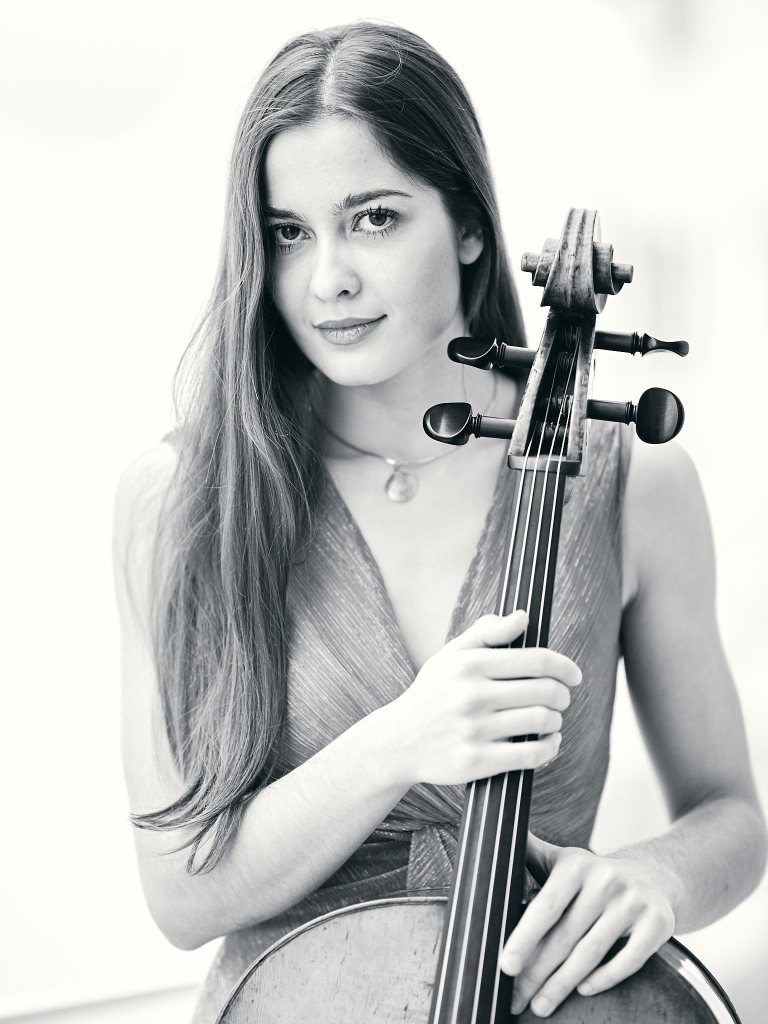
L.Park: How does the technique differ between a classical and a baroque cello?
Annabel Hauk: I would take the vibrato as an example. In baroque music it’s an ornament, so we use it for special notes or harmonies, and in the classical music, we use it almost all the time. I actually think that we shouldn’t use it as much as we do, but we use it way more in the general playing, like if you play Edward Elgar‘s cello concerto, it’s special if you don’t vibrate (because we are so used to interpret it with a lot of vibrato). Then, there is also the sound that is much different, as I said, there’s much more power on the modern instruments, whereas in the baroque music it’s a quieter sound. But I personally find that the colors on baroque instruments are more plural, so for me, it’s a music that is more soulful.
L.Park: You talked about modifying, if I understood correctly, your cello to make it like a baroque cello, how do you do that? Do you found pieces, build them or buy them?
Annabel Hauk: I buy them, for example the gut strings, you can find them at any luthier or online (like on Pirastro). The tailpiece I also buy from a luthier, as for the end pin, you just need to take it out, and then you can put something different on the bottom. So at the end, I only had to buy the baroque bow.
L.Park: Are there certain playing techniques that are more recent than others?
Annabel Hauk: For sure! If you listen to the old recordings from fifty or hundred a years ago, you hear how the playing has changed. I would say that if you listen to the old masters, you will remark that they use vibrato in a complete different way: they slide differently (and more I would say). What I realized with the cellists, for example, is that they sit way more still: all of their moves are only the ones necessary to create the sound. So sometimes, you only see the arms and hands moving, but there is no movement from the head and so swinging, which is what cellists from today do. Now if we talk about bow technique or left hand technique, I would say that we have different types or schools, but at the end it’s physics. But since we are performing on the same cellos since a hundred years, we preserve the same physics: therefore, the techniques might have been developed, but the roots are the same.

L.Park: How does the sound changes depending on which cello you play?
Annabel Hauk: The instrument itself is the tool you use to create the sound: I’ve played on different instruments and I must say that I prefer the historical instruments.
My experience is that they have a little bit more character: I also played on the more “modern” instruments and they’re a little bit more like a white wall on which you can paint. So it’s not an instrument that already has its own personality that you need to work with, so you put more of your own ideas on it. But I personally only practice and perform on my cello: I am not changing a lot.
L.Park: What difference can you find in your playing when you perform in a church compared to in a concert hall?
Annabel Hauk: I think you can use the acoustic of a church for your advantage, and that most musicians love playing in rather boomy halls or churches. When I play in a church it’s mostly Bach, so for me it’s also a spiritual performance in some ways. In a concert hall, I would say that it depends, because there’s so many different types: from a living room to a salon, to a rather big town hall, to big concert halls, etc. So you have really different types of spaces: you have to adjust your playing to the environment.
When I play in a salon concert, it’s really intimate, and you can talk to the audience after or even during the concert and that’s a type of experience that I really enjoy. When I play in a bigger hall it’s a little bit like you’re an actor in a theater and you have to be aware that you have to reach the last person in the concert hall. So you try to communicate a different way and to be aware of the sound and articulation.
L.Park: How do you prepare yourself for a concert?
Annabel Hauk: Yeah, that’s a good question. It depends: when I have to perform a program that I’ve already presented several times, it’s of course easier. But still, if I’m really busy, I always make sure that I work through on that difficult passage some weeks before. During those practice sessions, I ask myself: is it still in my fingers or do I need to go through it in my mind and to listen to recordings. And when it’s a really important concert, I practice and record my performance: this allows me to replay it as many time as I need, for me, my friends, etc. I also try to organize little concerts in my school, in Mozarteum, to get in the flow of playing a little bit more.
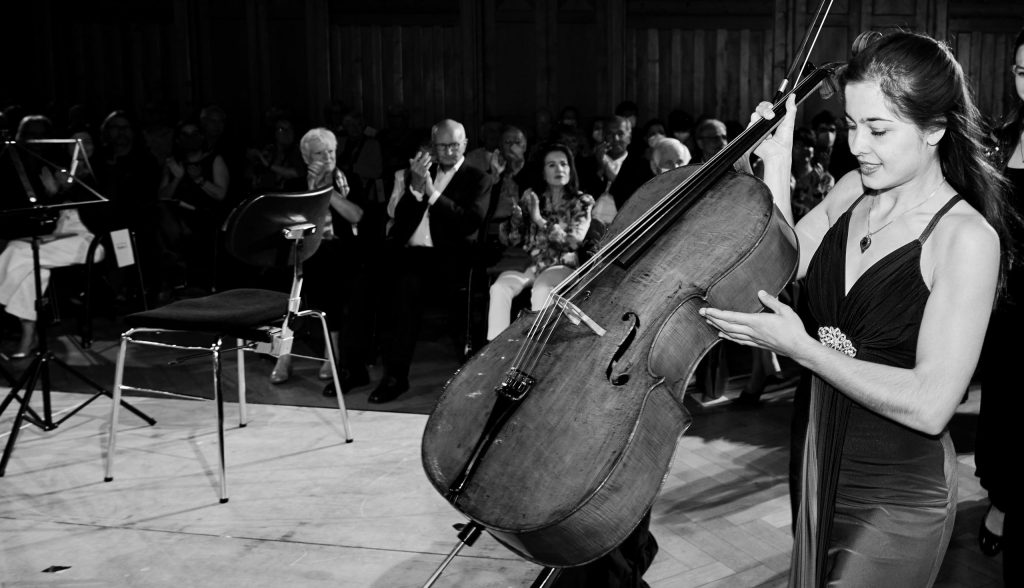
L.Park: You have performed pieces from Bach to Schumann. Is there a particular composer whose work you find especially challenging to interpret?
Annabel Hauk: I personally find that Bach is still the most challenging to perform. His Cello Suites and Sonatas for viola da gamba and harpsichord that I play, are also pretty difficult. But the Cello Suites are for me more complex: the interpretation, the intellect, the tension over the suites, the spiritual part… There are so many ways a musician can interpret those. I would also say that playing those pieces by heart are personally, a big challenge for me. For example, the sixth suite that I’ve been playing for a long time, is still tough to perform in front of an audience.
L.Park: Why is it such a challenge for you, is it memorizing it?
Annabel Hauk: Yes. I think, that it’s because of the complex and dense harmony. Plus, there’s no melodies really — maybe in the slow movements — but I wouldn’t call it melodies. For example, when you play Schumann, or in romantic concertos, you have it inside of you. But Bach‘s suites are different: it’s a challenge to know everything, even if you performed it a lot of times with different conductors and orchestras.
L.Park: How do you adapt yourself to other people’s vision of the pieces you are playing together?
Annabel Hauk: Let’s take chamber music as an example: yesterday I had a rehearsal with a pianist and we’ve never played together before, and we had to work on Beethoven‘s fourth sonata for the first time. So we started talking about how we wanted to interpret it as a duo, and we have to try different things before make our decision. And sometimes, those decisions are made spontaneously while we are performing. But I would say that you need to know how you want to play it, and also keeping a space for listening and accepting other visions of the piece.
L.Park: Finally, if you have to release one album, with whom would you collaborate and which pieces would make the cut?
Annabel Hauk: This is a question I cannot answer right now. to be honest, because there’s nothing concrete. What I can tell you is that I started recording the Cello Suites from Bach, and I really want to record all of them in the next years. And I know that maybe musicians have already recorded their own version of those pieces, but it’s a project that is close to my heart.
Photo © Andreas Malkmus




 The Musician Insight
Leave a comment