
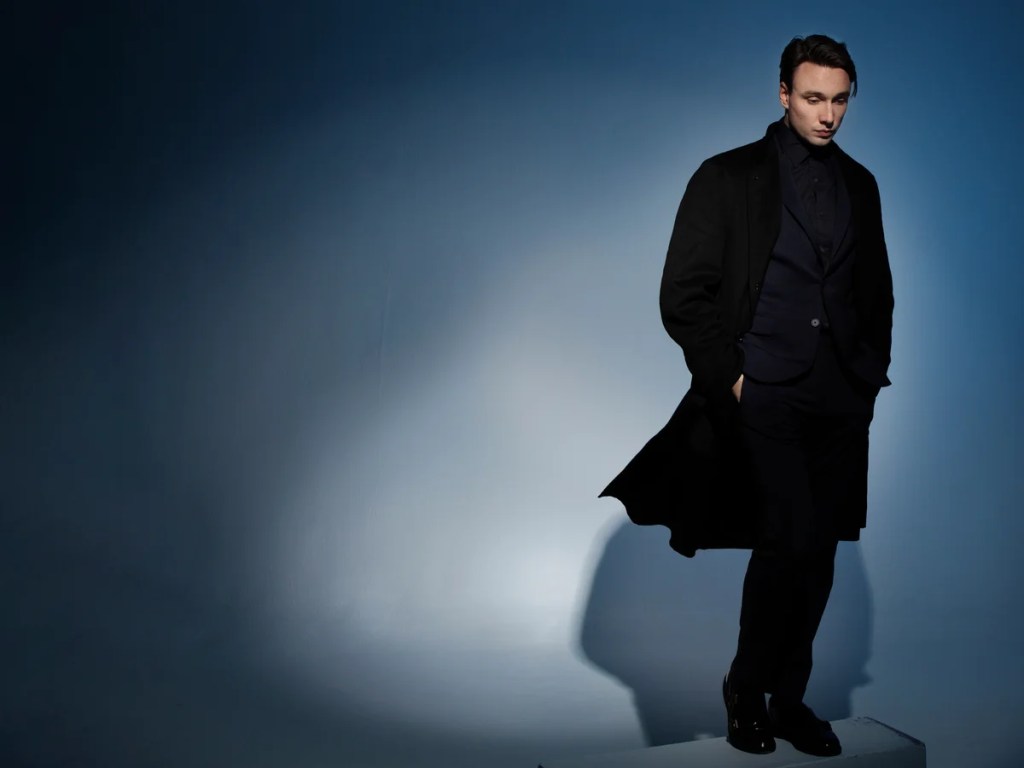
L.Park: Being an opera singer is like a gymnast. It requires a lot of practice and technique. How do you take care of your voice?
Huw Montague Rendall: I think that the body kind of chooses its own mood, right?
So depending on what we do to it, how we work it while singing, it influences on our journey to recovery.
For example, if I’ve been singing really hard, the best thing to do is rest. Like a gymnast, if you’ve been pushing yourself, you need to stop for a while.
And then a lot of hydration, a lot of stretching, like vocalizers and these kind of things. Also just trying to limit your injury scale: don’t do anything that’s going to push you too far, where you can get hurt: be careful.
L.Park: You’ve performed many roles, which one allows you to sing with the greatest freedom?
H. M. Rendall: It’s interesting because you’re right, there are some that don’t line up with that and they are also marvelous roles.
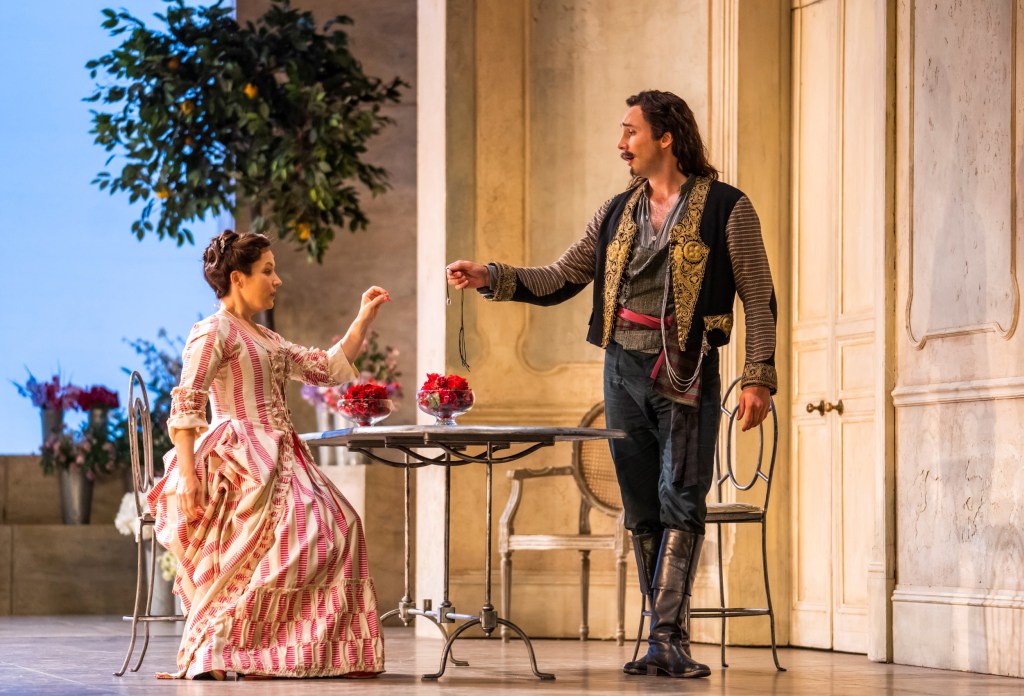
The Count, for example, in Mozart‘s Marriage of Figaro, isn’t that vocally freeing.
It’s quite demanding of a certain aspect of one register, whereas the rest of them can be a bit, not neglected, let’s say, but I think the one that gives me the most freedom though is Pelléas (in Debussy‘s Pelléas et Mélisande), because it’s heaven to sing.
You have these amazing long phrases, lots of high notes coming out, but beautifully written. Then text moments of real like intense speech, rhythm, text, and it’s amazing to sing. Another more “freeing” role would be Hamlet (in Ambroise Thomas‘ opera of the same name) is also wonderful to sing, but Hamlet is more difficult in a way because it’s more dramatic in the middle scenes, with example the ones with the mother. But I don’t know… French repertoire in general, is very freeing for me I find.
L.Park: Last year, you released your first album, Contemplation. How did your work with Ben Gainsbourg and the Orchestra of Normandie was like to bring this album to life?
H. M. Rendall: It was amazing really, because Ben and I, we’ve known each other really well. For this project, we didn’t had the time to actually go and rehearse things together, so we met on Zoom.
We spoke about what tempi we’d like and if there were any dangerous points where I needed to breathe, etc. And then we kind of left it to the studio to face these songs that we didn’t really over-rehearse them. We kind of let them happen naturally, which was an amazing experience because, you know, we’re used to rehearsing within an inch of the life before we go into the recording studio and then trying to make it perfect.
Whereas we were actually trying to create new things in the studio, which was an amazing thing. And the orchestra was so reactive to what we were feeding them, so detailed. As soon as that red light came on for the recording, they were instinctive beyond belief to what was being thrown at them from me and from Ben.
So Ben was on one side and I was on the other side and we were kind of surrounded by this orchestra. I was in the middle of the orchestra between the violins and the violas. And so, we were really kind of a big team, creating things spontaneously.
If we didn’t like something, we’d go back and do it again. Or if we thought like: “Oh, that was a nice idea, let’s do it more!”, we’d go back and do another take of that same thing.
But they were all just so professional, so emotionally open, and wonderful.
I loved it so much.
L.Park: Could you explain like the recording process for opera? Is it very different from other musical genres?
H. M.Rendall: Yeah, I think so. Because we’re all doing it live, right? We’re not dubbing tracks, layering things down like you can do in pop. It’s not being built on the computer, or on a software. It’s all being recorded by live microphones there and then.
So it’s then got to be mixed within that live thing from the producer, and that makes it not as free, as let’s say, a different genre. When I was a kid, I was in a band and we made quite a few recordings in the studio and we tried to make it as live as possible.
But of course, you then do have to layer things on top, because there are only so many people in the room. There’s one person playing the drums, who also has to play the tambourine or something later on over the top, or the singer has to sing a certain part and then play a percussion, etc. So as opera singers, we don’t have that kind of space: it’s not a technical operation.
It’s just trying to catch something, you know, like Ghostbusters: they’re just trying to catch the spirit. But with opera, it’s hard to get a sense of theatricality as well.
That’s one of the most difficult things to capture, which is why, the recording process for Contemplation was so special. It allowed me that freedom to capture things happening in the moment. Another tricky part of recording in the studio is to capture something that seems to be live from the stage: you want to hear the tension between the characters.

L.Park: In Contemplation, we can hear works from well-known composers as well as more niche ones. How important was it for you to introduce the audience to lesser-known pieces?
H. M. Rendall: Yeah, I think we have a responsibility to uphold the compositions of people who have possibly been overlooked.
For example, the Messager in this program, I didn’t really know before. And it became such an amazing piece, like the highlight of the album for me is this piece.
I think we do need to bring in either new music or undiscovered things into mainstream programs as well. Because we all know our big arias, from Faust or La Traviata, etc.
But there are some really, really good works out there that speak very true to a personality that we don’t know.
All these composers were human as well. Technically, they were writing pieces, but because of how they felt. And it’s that emotion that they felt first, that can resonate with us.
That’s why it’s important to search for undiscovered or lesser known works by famous composers as well. There are lots of those as well. In my next album, we’re going to dive into those kind of things as well.
L.Park: Performing on stage and recording a piece, how does your singing or interpretation change between the two?
H. M. Rendall: Yeah, we try not to make it change the way we sing in the studio compared to on stage, but of course we do.
Because we try and catch more nuance in the recording: we can sing more quietly, you know, adapt yourself to the microphones. We don’t have to push the voice into the space. Well, not push, but don’t have to put the voice into the theater. The mics are close up that they capture a lot more of the text, allowing us to be a lot more gentle. Whereas in an opera house, you really need to demand a lot of the text. But the technique stay the same, what is hard during the recording process is the fatigue.
It is exhausting, this process. For this album, we recorded from ten till six, every day for four days straight. So I was getting up at six o’clock in the morning, having breakfast, waiting, you know, warming up slowly.
And then by day four, you’re really crawling your way to the finish line. Your voice is knackered and you still have to record beautiful things, so it’s tough. Whereas on stage, yes, you do have to sing hard, for the entirety of the piece, but then you have a day or two to recover.
It’s very, very tiring. And a lot of my colleagues, when I told them that I was making this album, they said: “Oh, it’s the most tiring thing you’re ever going to do!”. Me I thought: “It’s not going to be that bad”, it was that bad [laughter].
L.Park: How did you manage for your voice to not disappear?
H. M. Rendall: Well, it was trial and error.
You have to program how you think your voice is going to warm up and then not get so tired. So you want to do some of the dramatic stuff at the beginning, but you need to warm up into that. Because you need the power of the voice early on, and then later, you can sing more lyric stuff, which actually I find more difficult.
During the recording process of Contemplation, we did a lot of the lyric stuff first, then dramatic stuff later, going back to the lyric stuff in the end. We started with the French repertoire first, with Hamlet.
After, it was the Duparc, and I think that Mozart was the second day and then Malher was the day after, but I can’t really remember.
But it’s all about the programming, and sometimes you can say: “Look, actually, my voice isn’t going to do this right now. Can we record something else?” and that’s fine too. You do have that freedom, which you can’t have on stage.
L.Park: How did you know which take to keep and which one to redo?
H. M. Rendall: The sound engineers have all of the takes on file, right? So when they’re editing, they do a first edition, and you need to have a responsibility to ask what take you thought was great when you did it.
So if you think you performed great on a certain track, you need to find which one it was and write the track number down. And if they choose something else in the first edit, you can say: “Actually, can I hear take three, six, or two?”. Then they play you the tracks you chose, and you can make your choice.
And you have a whole list of thousands of files that they can then take from and kind of jigsaw together, if it doesn’t work as a whole. When I choose a track, I need to feel what is in the right mood. But sometimes the singer is not the best judge of that: you want to hear something that’s technically proficient, whereas the sound engineers listen to the whole sound. Then a compromise needs to be made and you need to work with the teams, that helps to piece everything together.
L.Park: Which repertoire do you prefer to perform?
H. M. Rendall: I mean, I always love what I’m performing at the time, right? So at the moment I’m doing a Donizetti opera here in Barcelona. That’s really fun for me because it’s a comedy and it’s silly and fun and I get to have fun doing that. I personally love, though, I think on top of everything, the emotional, torturous pieces like Pelléas, like Hamlet.
Even the Count in Le Mariage de Figaro is fun to perform, because he’s having a tough time.It’s a very difficult evening emotionally for him, because he’s losing everything, so that’s really fun. Don Giovanni was another role that I really enjoyed performing, because I like the more complicated emotional characters in operas.
But in song as well: I really would love to sing Winterreise by Schubert and Dichterliebe by Schumann! All of these kind of emotionally, torturous pieces that, I don’t know, speak to me somehow.
L.Park: If they is one role that you like to perform, which one would it be?
There are many that I would love to do, but one that is always going to stick out for me, because it leans into that exact thing that we were just talking about, is Onegin in Eugene Onegin by Tchaïkovsky. I feel like I would be able to see a lot of myself in that character and, you know, you just need to wait for the time for the voice to mature enough to be able to sing it.
That’s the hard thing, but we’re getting there, slowly. I’m 32 now, so maybe by the time I’m 40, I might be starting to sing that kind of repertoire, which would be great.
That and probably, in the limit of my lyric repertoire, Rodrigo in Don Carlos would be really fun to sing! I would love to do that one day… But again, my 40s await.
L.Park: Finally, do you have any new projects in the works and could you share a little about them?
H. M. Rendall: There are certain recordings that were coming up that I’m really excited for…
Well, it’s going to explore more of the song side of the repertoire with some brand new pieces, that are very dear to me. And also some works that are much more standard, wonderful repertoire in English. So it’s going to be a lot of fun!
Otherwise, lots of wonderful recitals coming up with some great friends of mine. I’ll do three recitals: one in Strasbourg, one in Paris and one in Madrid next April with my wonderful friend and collaborator Helio Vida.
We’re going to do some really great, great repertoire: some Fauré, some Schoenberg, some Mahler and some other lovely pieces.
Repertoire-wise, I’ll do my first Dandini in La Cenerentola next year. and I also got my first Barbieri in Barbieri di Siviglia coming up, and my first Figaro.
I’m just kind of lucky to be able to keep singing and exploring new kind of things.
First photo © Simon Fowler 2024 Parlophone Records Ltd undefined




 The Musician Insight
Leave a comment