
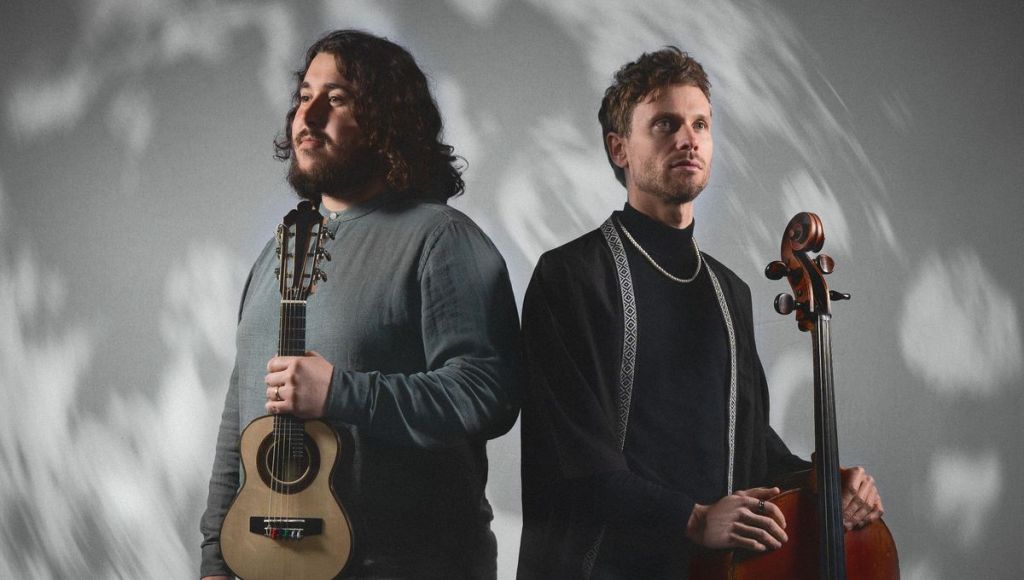
L.Park: Could you tell us how the duo came about?
Guillaume Latil: Matheus, hermano ?
Matheus Donato: Our duo was born from, I think, my arrival in Paris. I came to live there and I met Guillaume, a little by accident. As life can be.
And as every musical ideas that I find interesting, it’s something that came naturally, with two people having a lot of creative chemistry and also big differences. It allows something original and polished to appear
We started in a way, when we met, that wasn’t thought through in a way. We didn’t have arrangements, we didn’t have an idea of what we were going to do. It was really like a jam session between two musicians.
It was later on that we started to compose for this ensemble, so at first it was more of a natural encounter, and to see where it would take us, as friends first. It was when Mathieu came into our creative world that we started to take things more seriously.
G.Latil: We also met because we were living in the same building: I heard him play once, through the door and I thought that his sound was amazing. It gave me the desire to play with him.
L.Park: Hémisphère is your first album as a duo. Could you take us through the process of creating this opus?
G.Latil: We tried to read out to each other, in a musical sense.
And, for my part, it came naturally. But at first, because Matheus’ instrument is a traditional one, we started to play choro pieces that I knew and he taught me so many more.
That experience gave me the need to go towards more neutral territoy, towards a music that wouldn’t belong to me or him, but something crafted for both our instruments.
So this creative process was there: it was always making sure to create a sound, without the general esthetic belonging to a tradition.
M. Donato: And to add something to that, I think that Guillaume composed a lot more on that album, for our ensemble and for both our instruments.
He worked a lot on that, and I wanted to mention it because it’s a compliment that I receive a lot, but it’s Guillaume who makes sure that both the cavaquinho and the cello sound good together. He thought about each note, every phrasing, and it helped us a lot to create something that isn’t juste a live recording, but well-thought arrangements.
L.Park: Your music can be seen as belonging to the hybrid or experimental genre of music. How do you blend of your influences do create something that is unique to you?
M. Donato: The first thing that attached me to that project was Guillaume. He’s someone that goes deep into his musical influences, whether if it is cultural of traditional musics.
For me, I’m really open to play things that aren’t from my country musical universe. So I think it’s a perfect match to create something that is diverse. Guillaume already has that in his music I think, and for me, that’s what creates that musical universe that is so multifaceted.
G.Latil: Yeah, I think that, because Matheus has a very direct connection with a specific traditional music, he’s character is very strong. On top of that, he’s really open and curious about all things
As for me, I don’t have that same chance: I don’t belong to a tradition in particular.
Except maybe, classical music — which isn’t considered as a traditional music per say.
I also belong a little to the jazz manouche culture, that I personally see as a traditional music but which isn’t really one either. So for me, I come into those worlds with a diving gear, to immerse myself into a universe that’s not mine. And I look to all of these things with a lot of love, but with oxygen tanks because it’s not my world.
And because of that, I couldn’t present to him a traditional music in particular. That same thing helped us create our album, because we started in a neutral universe, where Matheus was open to any proposition.
There was some tracks which were composed on sheet music first, but most of our work were almost “oral” compositions, like Prière en Bambara.
So yeah, he was really open to work through the sheet music and to work on different types of sound. With sometimes more humility than needed where he would say: “But I don’t improvise well those chords in that way”. And I would listen to him and try to understand his vision, thinking: “But what does he find bad? It’s so beautiful, so precise and lyrical”.
L.Park: What does the term Hémisphères represent to you?
G.Latil: Hémisphère is a word that is quite similar in Portuguese and in French.
For me, it first evokes geography, and I thought that it was vague because when we say north hemisphere, what does that lead to? What’s common to a Sicilian and Norwegian fisherman — culturally, there’s not a lot.
So it brings together people that are really different, and people that are the same. It gives that feeling of something ungraspable. And I thought that it was a beautiful term, because we are ambassadors of those differences between the North and the South but also of there cultural wealths.
Hemisphere also represent something rectilinear: we see the equator but at the same time the word sphere evokes all of those resonances.
M. Donato: The word was first proposed by Guillaume, and I thought that it was beautiful, because we both come from different hemispheres of the world.
And I love the idea of belonging to the South hemisphere, because there’s a lot of groove.
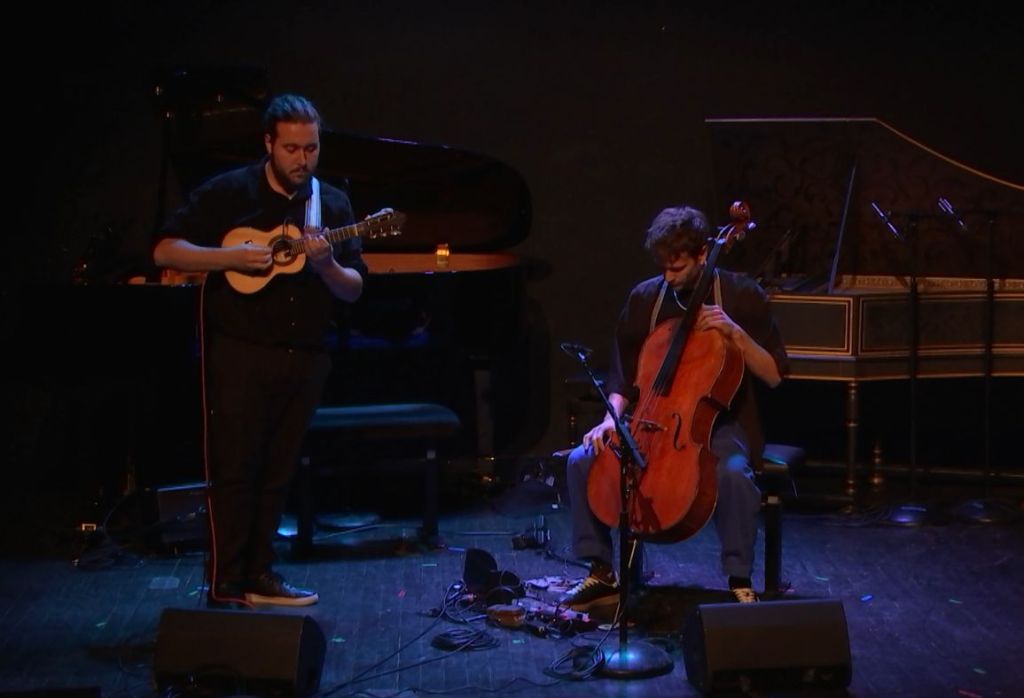
L. Park: Throughout this opus, you explore different playing techniques. How did those choices influenced your way of composing and interpreting?
M. Donato: The work that we do puts me into an interesting position as a researcher seeking ressources from my instrument, or as someone who plays weird things at a level that is interesting at least.
And I think that this research of playing an instrument that is mostly played in a certain way, like in Bresil or in Portugal… I try to break all of those rules in that album. I believe that it’s something important, because I can’t not do it. And it also gives it a richness in sound in that project that helps us experiment.
I’m extremely curious, and I spend a lot of time writing to develop new ways of playing. And I think that it really helped me for that type of work in our album. I know that Guillaume does also a lot of research on his instrument. So, I really believe that all of this is the result of two mad scientists who met each other, to create this opus.
G.Latil: For me, it’s not just the different playing techniques that influence us, because we also compose to find those new techniques.
For example, we have three-four tracks like that: the idea is to propose a concert. So we search the form which corresponds to how we share music nowadays.
So it’s about an hour and fifteen minutes of music, with two instrument. But none of which is complete in terms of harmony, like a piano. There’s no bass… it’s quite complex. That makes us quickly run out of possibilities, and it would be a shame to not use the sounds that are a little conventional.
Sometimes, a certain sound inspires an idea, towards a country. And we think: “What can we find something new? What do I want to hear at the cavaquinho or on the cello?”.
The track Urban Poem was written in that spirit.
Something else to consider, is that it’s very easy to write a cello accompaniment in pizzicato, because it‘s works very easily. The cavaquinho is an instrument with a pretty high register: with the pizzicato, we already have something rhythmic, or a traditional bass so to speak.
You can compose days of music with that kind of formation.
But with the bow, it’s more complex to improvise: it demands a strong bass motif. That’s the reason why Urban Poem was created, it’s really the result of a search for new ways of playing.
L.Park: Which piece required the most patience from you to compose for this album?
G. Latil: For me, I think that it was the one we were just talking about: Urban Poem.
After, I presented it to Matheus and he was enthusiastic, unlike me. Then, we talked about it, and I mentioned that I wanted to let that one go. I had three other pieces that were a little longer, and we were in the process of selecting which ones to include in the album.
At one point, Matheus told me: “What about that piece you played me a while ago? I think we have something special here.” To be honest, I was surprised: it gave me the desire to listen again the voice memo of the rehearsal.
I really felt like it wasn’t finished. I spent a lot of time in the train, re-working it, searching for a main theme that would go almost to the end of the piece. The almost-like chorus of the piece wasn’t the basis at all: that’s what I love about composing. It always very confused, but sometimes, it all comes together in one flash.
Yeah, so most times, the final result doesn’t correspond to the path. But going back to Urban Poem, it was a tough ride for Matheus: the sheet music was highly complex to sight-read.
M.Donato: As for me, I have a rather light relationship with my released works.
But going back to your question, I think that we find a good path together. Especially on the tracks Aos Meus Amigos and Oriente. Pierre Perchaud, our artistic advisor helped us a lot.
L. Park: How do you manage artistic disagreements?
G. Latil: Violence [laughter].
M. Donato: [laughter] No, but as a duo, people tend to think that it’s easier because less members equals to less problems. Which, to be honest, is not the case at all: you have a lot of personality and responsibility from both sides and more decisions to take as two people.
Which is why having a team is so great: they were the ones making the final decision for the album.
And we definitely have been in a position where we both disagree, but we always find a way out. That’s the ingredient, I think, for a coherent project and for the success of this opus.
Art is more precious than being right.
G. Latil: By the way, they were moments where I personally didn’t handle well those arguments. Because working on the same project with someone else can be tough, and we’re still learning. I hope that for a next project, I’ll be better on what Matheus and I discussed — which is another thing that helps us stay connected: communication.
L. Park: Different music genres present both similarities and differences in their musical structure. How do you evaluate which aspect to keep and which ones to modify while composing?
M. Donato: I believe that, because I come from that traditional music background, my direction in this project was always to go towards something else.
Because without searching for it, I automatically put this way of thinking music in an idea or a piece. So I think that when I listened to Pierre and Guillaume’s advice regarding the compositions and arrangements that I was proposing, I tried to keep that was experimental for me.
It was ideas where I was somewhat reluctant, especially because they were artistically experimental.
Therefore, this work conveys a universe that also belongs to me, but one where I’m really open to be more natural in a way. I kept the ideas of Guillaume and Pierre in my compositions, that enriched them and that gave me insights that I never thought of before. And that’s something super interesting.
G.Latil: I think that I couldn’t give you an answer more complete than him because it’s tough for me to deeply analyse this phase of the work.
In this case, it’s quite subjective : it comes in the moment. There are things that we keep and other that we don’t.
I think that it really depends on your tastes, the esthetics that you are seeking, etc.
We suggest an idea, share our desires, modify a part whether because it doesn’t correspond to our tastes, or because it invokes something that would be too vulgar in our cultural perceptions.
For example, it could evoke something a little too cliché, and we always run from that kind of stuff. It’s a sort of filter that we keep at all times to know which things we keep or not.
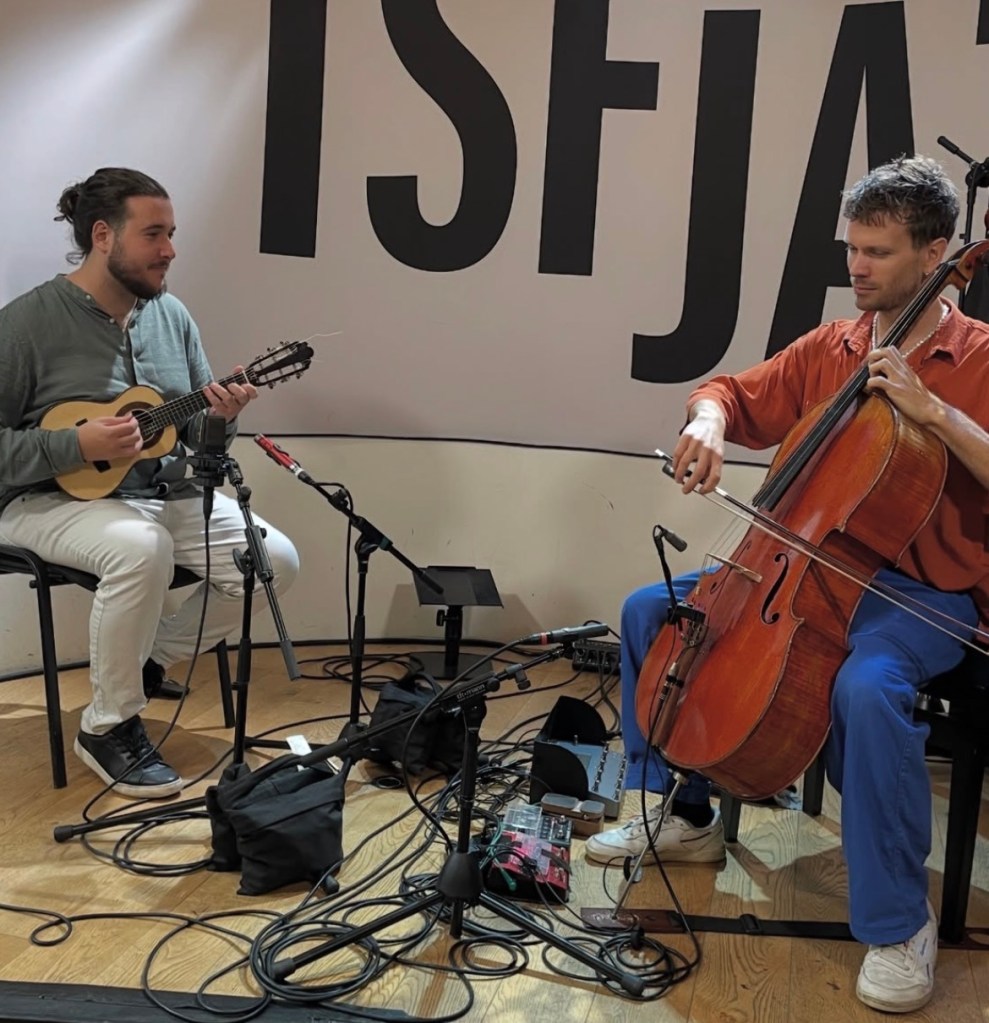
L.Park: Instrumental music can be sometimes perceived as difficult to access due to its lack of lyrics. How do you convey your emotions and experiences through the score?
G.Latil: The sheet music only serves us as a basis to share the music with each other. But they don’t have a vocation, like in the classical music world, where the score is a witness to the piece in itself.
The reason why we need the score on stage is to have a direct connection with Schumann for example. Even if we know the piece by heart, we can still perform with the score in front of us because it is a reminder of the person that composed the piece.
But for our music, it’s more in the oral transmission category I would say. Therefore, the sheet music doesn’t testify of the same things compared in classical music.
Instrumental musics are, however, less trendy compared to music with vocals. Especially in our time, where we seek music that is easily marketable to sell.
There were even several booking professionals, who told me: “You’re project is beautiful, but I only do vocal music because I need things that sell”. That really shows where we stand as an industry right now.
This right here, it matters to me. It makes me want to defend instrumental musics even more, and I try to compensate this difficulty that is evolving. The first thing is by speaking on it of course, to break the ice, especially on stage and to show how we are guided by the music.
When we listen to instrumental music, it’s not the same experience as with songs, where the lyrics are guiding you. “I’m all alone tonight” and we imagine a man in his house, all alone, sad. But with instrumentals, the listening experience is even more important, because there’s no lyrics.
In a piece for cello by Bach for example, you have different fugues with several voices, and one melodic instrument. And this piece can’t work if the listener isn’t invested in their imagination, trying to continue the low voices that will soon disappear. So there’s really an intrinsic implication of the listener and that’s why that type of music is so beautiful.
L.Park: Finally, if you could do any other type of project, musical or not, what would it be?
M.Donato: I know that Guillaume and I really want to do another album.
We would love to try new things, new arrangements and repertoire. I would love to dive into something more percussive. As for my solo projects, I will soon record something new that I’m very excited about.
G.Latil: As for me, I would first like to enjoy all the things that we achieved.
For the second opus, the challenge would be to re-use the recipes that worked, but also to not be to redundant, which is really exciting!
For my solo works, I would love to compose an octuor for cello and record a new album with modern sonatas for piano and cello.




 The Musician Insight
Leave a comment