
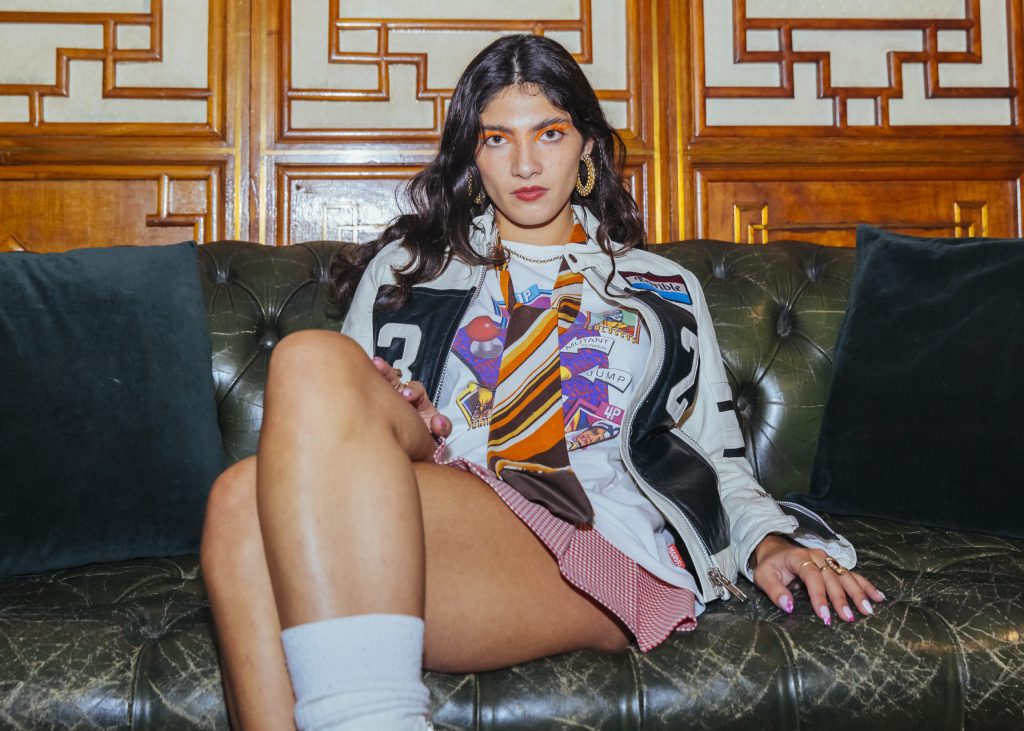
L.Park: Your first EP Solide, includes two songs (L’acharneur and Ton travail ou tes fesses) denouncing misogyny and the harassment women face. How do you approach these deep subjects as a songwriter?
Déborah Leclercq: When I think about those songs, I didn’t seek to denounce anything.
I didn’t tell myself “I’m going to write feminists songs”. At that time in my life — when music wasn’t a project of mine — I met André Manoukian and all of these emotions were coming out in an honest way.
It was a period where I realized that I didn’t feel safe in the streets and that I wanted to wear what I wanted without being scared or judged.
I was also going through a lot in my work: I was doing meeting after meeting with people that were in the game since ever, and I didn’t understand why they were talking to me. And I always felt like those people in power only came to me to flirt and not to help me.
L.Park: By the way, how did you meet André Manoukian?
D.Leclercq: That’s such a crazy story.
At the time, I was in theatre school to become an actress. So at the beginning, I never thought that music would be a good path for me.
Then one day, I posted around two or three short covers on my social media because I loved Georgia Smith, around the same time that I started following the Belgian comedian Stéphane de Groot.
And he actually liked my videos, which I remember thinking “What is actually happening right now?”. At some point, he contacted me, asking if I was a singer and all of that.
After a few weeks, he messaged me again, asking me if I wished to meet a friend of his, that listened to my videos and fell in love with my voice.
Turns out, that friend was André!
He sent me a message via Instagram and we met around January in 2020. And because I had no pressure, we laughed a lot during our conversation, I told him that I loved Charles Aznavour and well… I won!
After our meeting, he told me that he wanted to produce my first EP, and I remember thinking that it was insane like, it was happening so fast!
L.Park: So, how did you feel after that proposition? Did you say let’s do it or did you think to stay in theatre?
D.Leclercq: Because I never wrote a song in my life, I was open to that proposition.
But I was a little like “How is it going to work?” and he told me to not worry about it, that we would have writers, etc. And because André has such a positive energy, I decided to try.
When I came home, I actually told my brother (who did a lot of music and had his own group) about the whole encounter, and he was the one to tell me that it would be better if I wrote my own songs. Because if I was “only” there to sing, with a huge team around me, I would be completely drowned.
And that was the reason why I started writing.
L.Park: But how did you learn to write music, with no basics at all?
D.Leclercq: At the beginning, what really pushed me was Covid.
The whole world just stopped in a way. So I told myself that it was the opportunity to learn how to write songs. I took my guitar, my notebook, and started writing all of my inspirations. I first started with already made productions that you can find on Youtube, to get inspired.
But at first, my songs didn’t have a chorus or a verse: I was totally free. And then, little by little, by meeting new people and working with André, things got better and better.
L.Park: Your new project, Maison, is entirely produced and composed by you. Could you share with us the story of this new EP and your way of working?
D.Leclercq: I would say that compared to my first EP where I was highly pushed by André and all the trust he put in me. But for Maison I was completely alone.
A short while after we released Solide, we decided to part ways, because we couldn’t make it work anymore: we had too many artistic differences.
And then, I told myself that I needed to get a break. Also, theatre was taking a lot of my time, as I was working every night on stage. But when we both decided to stop working together with André, I knew I needed to rebound and fast.
I was afraid to not find the strength again, so I didn’t”t really took a break. About a month later, I searched for people to collaborate with: producers, arrangers… And during that time, I met two great guys: Hugo and Sam who own USM Studio. We got along well and laughed a lot.
It was a new way of working because we had the same age, and so, the same references. With André, there was a mentor thing that was wonderful, but it was also great to see people with the same type of dreams. And then one day, I came into the studio and said that I wanted to do this second project on my own.
I wanted to do soul/new soul music, something that I already started with André but that I wished to go further. Hugo and Sam were enthusiastic about the project and I already had demos with five songs for the EP.
The reason why I already had all of those songs was that I worked on them years before, and I showed them to André, who turned them down. Anyway, with the demos, we started to search which directions we wanted, and the boys suggested an old sample of soul, like in rap.
The other big step was creating my own label, and I’m currently taking workshops to learn how to manage everything. I like to be independent and to do things in the right way, and I would love to also create my own production company. That would come in handy if I’m able to write that play that I always wanted to do.
L.Park: For your label, do you put only your own money or do you have external financing?
D.Leclercq: I did put some money of my own, with the help of my partner who also have a theatre production company Solide Productions.
Hugo and Sam also helped, and I also used money from competitions that I’ve won. So it’s a little of everything really.
L.Park: How do you come up with all the imagery to promote your EP?
D.Leclercq: That’s a good question!
To create all that universe, we always need help first. I had the privilege of working with great artistic directors, Lune Jarriès being one of them. When I met her, she was collaborating with my manager, which was also André’s manager.
Lune really guided me in styling my clothes, etc. and she actually was the one who did the Solide EP cover. But when I write songs, visuals usually come to me, I remember that the concept of voice and piano in a theatre was something that I visualized first.
For L’acharneur, it came from me being in my neighborhood with my friends. And for Interdit, I already had so many ideas! During Covid, there were moments where André was too busy.
So it forced me to work even more because I had nothing else to do. I would take my notebook, and wonder “Why does that song inspire me? What is it saying to me?”. Then I just close my eyes and see the situation, the world, the colors, etc.
Then, there are also easy concepts: like for Carton Rouge, it was obvious to have a football jersey, something a little second degree.
L.Park: You perform a lot in different concerts and shows, by embracing various repertoires. As a singer, how do you adapt your voice regarding the musical requirements and the pieces you interpret?
D.Leclercq: Honestly, I just try to bring my own spin.
The work for me, consists to focus on what the song means to me, what does the words tell. For example, the concerts for Gainsbourg’s homage that I did with André, Élodie Frégé, Nesrine and Awa Ly, I was trying to bring something personal while singing.
So I don’t know if I have a special singing technique for different repertoires, but I definitely think about them in different ways. And something else that also helps a lot is connecting with the other musicians of course: listening to them, keeping the words close to your heart, etc.
L.Park: Carton Rouge, the first single of your last EP, is having a big success. How did you approach this bossa-nova track, a genre that you are exploring for the first time?
D.Leclercq: Brazilian music is a genre that I absolutely adore, for years now.
I love listening to it, so I knew that I wanted to write a bossa-nova inspired song. And this track wasn’t something focused on football at first: I was just listing my imperfections and quirks.
So I had that rap-sung phrase that I immediately tried to put into that song, and I think that it was an old musician of mine JB who told me, because I had a sentence about football: “You should go for something about it”.
But at first, I didn’t know what to do with that song, due to the rap-sung technique that was confusing some producers. So I had to make it as simple as possible, and I contacted Robin, one of my musicians specialized in Latin music. He really helped me a lot with the production and overall structure of the song.
L.Park: You just finished a short tour in Brazil, could you share with us this experience?
D.Leclercq: It was an amazing experience!
I actually won this opportunity, by competing: I received an email from Groover Brésil and we were in May. And I learned that I won to do a tour in Brazil, but that I had to leave in June.
So I was like “Oh okay June 2026, I have time”. But no, it was June 2025!
I was doing theatre at the time, but thankfully, I had a friend that was playing the same role as me so I had the opportunity to leave for the tour.
We played in three cities for four concerts. It was a marathon but it was worth it for sure!
L.Park: Through all of your projects, we perceive a woman who’s sensitive, full of doubts, but also courageous. How do you manage to share those complicated emotions in such a simple yet complex way?
D.Leclercq: I don’t think, going back to the first question you asked me, that I have a certain type of approach.
I’m not like: “Okay, this needs to feel honest”, I feel something and put it on paper. And I think that when you adopt a mentality where you need to make a hit, it will set you up for failure.
For me, I need to take the pressure off, and I truly believe that things work because they just do. Something else to, is that the more you think you’re writing from a personal place, the more it’s actually universal.
So to conclude, it’s just me, my notebook and my computer.
L.Park: Going back to the theatre world, you are currently in the stage production of Mission Florimont in Paris. What are the similarities and differences between performing as an actress versus as a singer?
D.Leclercq: Personally, I find theatre to be easier, because we rehearse a lot.
When you do a play, you have two months of rehearsal, every day. But in music, I noticed that people don’t really rehearse. At first, I thought that it was only André and his musicians doing that, because when I came in to work on Gainsbourg, we didn’t rehearse the songs.
We came in for the soundcheck, and then we had the concert.
With my musicians, it’s the same thing: I’m always like: “Okay, let’s do a four-days rehearsal” and they are like: “No, no, two rehearsals will be fine”. So music is a lot of personal work.
And most of all, in theatre or in a movie, you’re hidden behind a character. But when you do a music project, especially when singing, then you’re basically naked.
I would say that what links those two, are of course, the stage. Its magic, you know?
L.Park: Would you be interested in musicals?
D.Lerclercq: Honestly, I love watching musicals but I’m very bad at dancing.
An other thing is the vocal technique: in a musical you have to really push your voice, with a sort of a smoother technique. And I didn’t really take vocal lessons, so I have my particularities, and I don’t think that it would please the musicals’ world.
But who knows, maybe one day I’ll find a role adapted to my vocal abilities!
L.Park: Lastly, do you have any projects that you would like to share?
D.Leclercq: I would obviously love to release an album, including around ten of twelve tracks.
And I would like to write a show between concert and theatre. The idea would be to bring two or three musicians on the stage, where I would tell my story, through songs and theatre.
The circus and theatre duo is an adventure that I would also like!
First picture © Margaux Rodriguez




 The Musician Insight
Leave a comment