
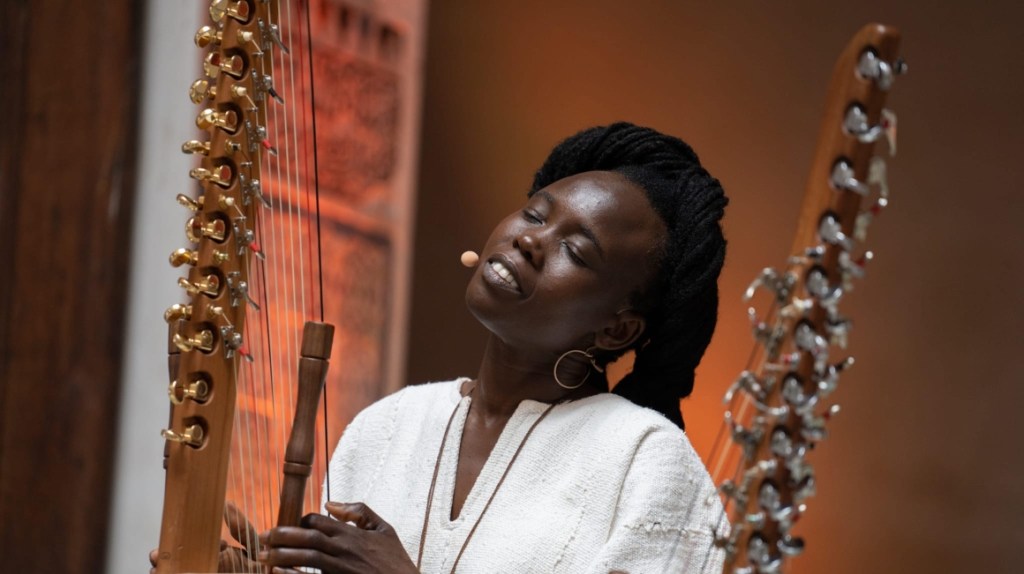
Luna Park: Your album Yéné represents a blend of different musical genres such as folk, Afro, and blues. Could you take us through your writing and recording process?
Senny Camara: Yéné is a mixture of everything, with a lot of my African roots (Senegalese, Serer, Manding and Wolof). For now, I write in Wolof, because it’s where I’m the most confortable. So this opus is a blend of traditional African musics, American music, Celtic music, or French music (French variety).
L. Park: While writing lyrics, do you also focus on linguistic aspects other than rhyme?
S.Camara: Indeed, I pay close attention to how I deliver my lyrics in Wolof. Because it’s a language that is hard to sing: it’s easier to rap or slam. So that’s the reason why it’s so crucial for me to be precise on how I write, and I also like to play with rhyme.
L. Park: Why is it not as easy to write in Wolof?
S.Camara: For me, Wolof is a language which is beautiful in slam or in rap, where there is a lot of rhythm. With that in mind, it’s not easy for me with my singing technique to write in Wolof: you have to learn how to lay down your voice.
L. Park: The Kora is a highly technical instrument. What are, in your opinion, the rhythms and melodies that are the most complex to execute and why?
S.Camara: The Kora is highly technical and complete, because we can play in different ways: to accompanied oneself while singing, to play the bass, or a solo… So it’s really an instrument that requires a lot of time and practice: it’s a tough instrument to tame. It still demands a lot of work from me, but it’s a very beautiful instrument and it’s a sort of medicine for me.
L. Park: Is there an artist that particularly inspired you as a musician and composer?
S.Camara: I would say in both my country and in the United States. In my home, there’s this singer that I call “my diva”, who sang with her husband. We used to call them the “royal couple”, her husband was a great Kora player named Soundioulou Cissokho nicknamed “the king of the Kora”. He would accompany her while she was singing, and they were times where I would be on the verge of tears from her voice. So she inspired me so much, and I can say that is because of her that today, I sing and perform, her name is Maa Hawa Kouyate.
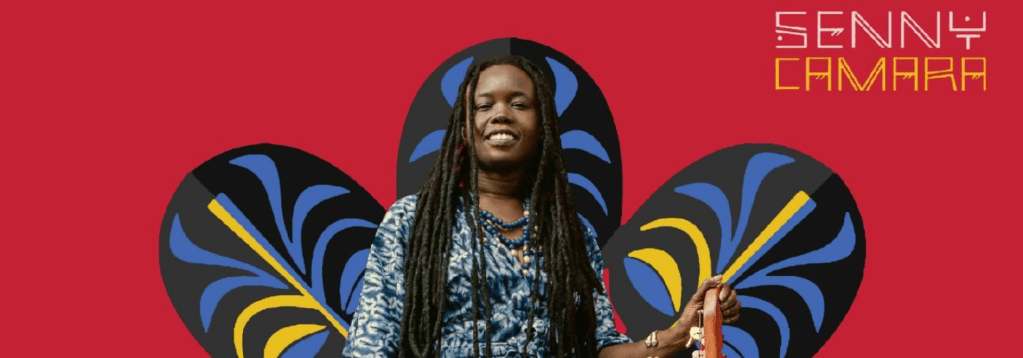
L. Park: You’ve worked with many musicians throughout your career. What are some of the most valuable lessons you’ve learned from working with other artists?
S.Camara: Of course! When I work with other musicians, I learn a lot of new things: there’s a sharing experience going on, and I prefer to use the term “share” compared to “work”, because we share as musicians. I love to work with all types of musicians from all over the world: it’s my dream to continue to travel and share — if I still have time on this earth (laughter). But yeah, I learn a lot about others, I love learning, that how I can get better.
L. Park: Do you have some examples of these sharing experiences?
S.Camara: Yes! There is a musician that I’ve been working with for ten years, he’s a guitarist, and I learned a lot of things with him. And he came to us, he learned our music and I often say to him: “Don’t feel obligated to follow my lead, I want you to put your own spin on it”. So, yeah I learned a lot through him and others.
L. Park: How was the process of creating the sound of your first studio album?
S.Camara: I was at the conservatory, and there was a lot of Celtic, Irish and Breton sounds, and it inspired me a lot. There was also the American folk, country, blues and traditional music from my country, so it was a blend of all of these different types of music that gave birth to Yéné.
L. Park: Was there a period where you had some difficulties while creating this opus?
S.Camara: There was a lot of complicated moments (laughter), because when you create an album, you are the only one doing all the work. At least for me, as it was my decision to write and produce this first record on my own, so there was a lot of imperfections through the recording process, but I decided to keep those, because life is made from flaws. You can’t have everything smooth, so there were moments where I had enough, when I felt like it was very tough. But I wanted to release my album with no deadline pushbacks, so it came out with its flaws and all.
So I did the album rollout by myself, well, I can’t really say that because they were musicians who accompanied me through the recording process, and we had some issues: for example, we had to switch recording studios, because I wanted a specific sound, and I wanted to record in live. And there are some tracks that we had to re-record afterwards, due to some technical problems, that aren’t live. But Yeuk and Yéné Nala are some of the songs that we recorded live: we did like two or three takes. And I really wished to do the whole in live but, things happen, so it was tough period.
L. Park: So how do you record live in a studio? Are you all in the same room or do you have separate booths?
S.Camara: We are in the same room, but if there’s a saxophone or drums for example, then they have their own booths. But the rest: the Koras, the harp, the Chinese zither and me (with my studio microphone), were all in the same space.
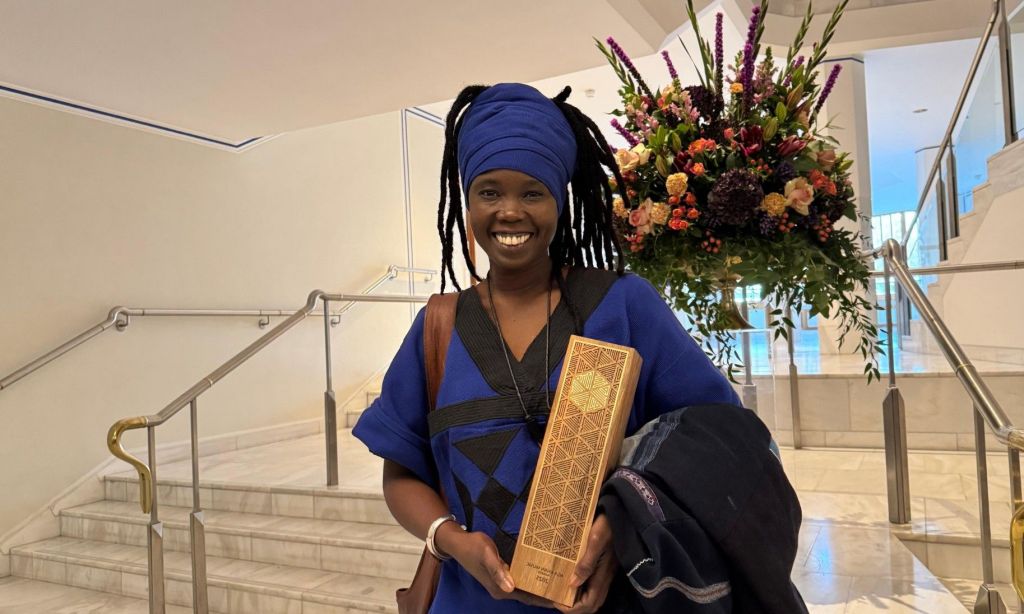
L. Park: What is your favorite part about performing?
S.Camara: It’s my favorite question, I love to be close to the audience, to share with them. To close my eyes and to travel with them and also after the concerts, I love to answer to their questions, it’s such a beautiful moment of sharing, it’s like a family.
L. Park: Life on tour can be quite complex, can you share a moment where you had to improvise?
S.Camara: Life as a mother in general is quite complex and intense: I have two boys, and sometimes we have to improvise in order to be able to show up on tour and to manage some personal issues at the same time. So it’s really not easy, but we learn to carry on and to have resilience.
L. Park: What is one characteristic of the Kora, that makes it so special in your eyes?
S.Camara: They are so many things about the Kora… The beauty, before even touching the instrument, and then when you are playing it… You are traveling through and with it, it heals you in a way. I also love to chat with my Kora when I don’t have time to practice and I often apologize to her, because as a mother, we have a lot going on at home. So yeah, there is something that I can’t quite describe about the Kora… it’s very powerful.
L. Park: Which type of musical genre would you like to explore for your next project?
S.Camara For a new project, I would love to explore healing music. A music about nature, denouncing global warming through the four elements (Earth, Wind, Fire and Water). All that I can say, is that this project of mine is definitely in the works.
L. Park: What is one aspect about a musician’s life you wish people would understand more?
S.Camara: It would be to share the music, to not fall into the system of becoming machines and not really caring where we go or what we play anymore. For me that’s not music, that’s not sharing with other people. I really love to come and meet people, converse with them, ask them if they have any questions, etc. It’s something deeply important for me, and I continue to do it every time that I perform.
L. Park: Finally, what is one thing you wish listener would keep in mind when experiencing your music?
S.Camara: To enjoy everything that is beautiful on this earth, everything that I stand for: living together, humanity, a look or a smile… Sharing something with others, and that in our planet everyone has its place.
Photo © DR-min

 The Musician Insight
Leave a comment