
Luna Park: You composed many pieces, from chamber music to orchestra works. How does your approach differ depending on the type of work you are composing?
Camille Pépin: In reality, my approach is the same for every piece. The challenge for me is always to write music that feels fresh and is easy for the musicians to interpret. However, I do recognize that writing for orchestra comes more naturally for me.
Luna Park: Your latest album Pépin : Les Eaux célestes, was recorded with the Orchestre National de Lyon and Ben Glassberg. How do you work with conductors while both preserving your artistic intentions and allowing them some freedom in the interpretation?
C.Pépin: I tend to let conductors do their work. On the one hand, I never studied conducting, which makes me feel illegimate when it comes to giving advice. But I believe that if I have done my job well, there shouldn’t be a lot of questions when it comes to interpreting the pieces.
Where I find myself more “useful” is during rehearsals, especially for the sound checks and understanding the concert hall’s acoustics. Since conductors are on stage, it’s interesting to have an ear in the public to ensure the balance of the sound.
Conductors sometimes take liberties with the tempi, and I let them because the difference is rarely very noticeable. Often, there’s a good reason for those changes, such as taking into consideration the acoustic of the room for example. Overall, I am not a tyrannical composer!
L.Park: In Confins de l’orage, we can hear some inspirations from Tchaikovsky and Stravinsky. How do you manage to appropriate those composition elements and to make them your own?
C.Pépin: You know, it’s something that comes naturally to me. For example, I sometimes play excerpts from repertoire works on the piano and I spontaneoulsy alter small details in a way that makes them “mine”. I’m probably not the best person to answer this question, but I think that my style is a kind of synthesis. A “digestion” of works by other composers that influenced me and that became a part of my musical DNA. And this happens unconsciouly.
L.Park: The Sound of Trees, another orchestral work, immerses us in nature and its elements. Which compositional techniques do you use to evoke the wind or the rustling of leaves, for example?
C.Pépin: More than compositional techniques, I use the orchestra’s colours to illustrate these ideas. I mainly rely on broad melodic flights and airy sounds for the solo clarinet. As for the cello and the other strings, I use a lot of sounds, mixing the finger techniques on the bridge. This helps create sounds that are as light and airy as possible. I also use a lot of harmonics for the strings.
L.Park: In 2019, you released the album Chamber Music, which includes the piece of the same name, your only recorded composition featuring singing. Does your creative process differ when composing for the voice?
C.Pépin: Yes, the process is different because it requires me to “begin” with the voice, whereas I usually imagine the overall structure and sound from the very start. In fact, the voice imposes the text and the text imposes the prosody. The other instruments then develop around them.
L.Park: You recently presented the world premiere of La Nuit n’est jamais complète (2025) at the Grand Théâtre de Provence. Could you tell us how this piece came about?
C.Pépin: La Nuit n’est jamais complète is inspired by Paul Éluard’s poem of the same name. It was composed as a prelude to my violin concerto Le Sommeil a pris ton empreinte. Together, the two works form a cycle carrying a common message: the possibility of a light within darkness.
While the concerto explores grief and rebirth for the person experiencing it, La Nuit n’est jamais complète evokes a hand reaching out in the dark, a fragile thread of hope. It takes one of the concerto’s key melodic motifs, transforms it, and enriches it with lighter notes, like a lit window in the night.
This work is conceived as a single continous mouvement, thought in a organic way, following an inner trajectory toward the light. In this piece, I wanted to express the profound desire to beleive in a light amid darkness. The challenge was to create, through writing, dense and evokative sounds despite the reduced forces of a chamber orchestra.
I have a lot of emotional memories from the premiere by the Royal Philharmonic Orchestra of Liège conducted by Renaud Capuçon at the Grand Théâtre de Provence. This piece is very close to my heart because it connects me to Renaud Capuçon, who iniated both this commission and my violin concerto, which he also premiered. It is because of Renaud that this cycle inspired by Paul Éluard’s poetry came to life.
L.Park: Throughout your career, you have composed many pieces commissionned by different institutions. How do you choose the theme and the overall direction of a piece? Are certain elements imposed on you?
C.Pépin: I find that the specifications for commissioned works are not very restrictive. Most of the time, only the instrumentation and the duration of the piece are imposed. This gives me a great deal of freedom, both in terms of the source of inspiration and the music itself.
L.Park: The pianist Célia Oneto Bensaid regularly performs your compositions. How did you meet?
C.Pépin: We met in 2012 at the National Conservatory of Paris when we were both students in composition. I think that it was the strenght of our personalities that connected us at that moment.
We were already deeply passionate about music, with the same devotion to art as well as a mutual admiration and humour. Our first professional experiences as colleagues were so powerful and natural, that we didn’t stop working together since. Célia was one of the first to believe in my work and to trust me, and meeting her was a turning point in my life. I believe that she has now almost performed all of my piano works!
L.Park: If you could compose the score for any film, which one would you choose?
C.Pépin: If I ever have the opportunity, I would love to compose music for a film in space rather than on Earth. But perhaps that’s because I listened to John Williams’ music, a little too much, although one can never really listen to it too much. So my choice may be slight biased.
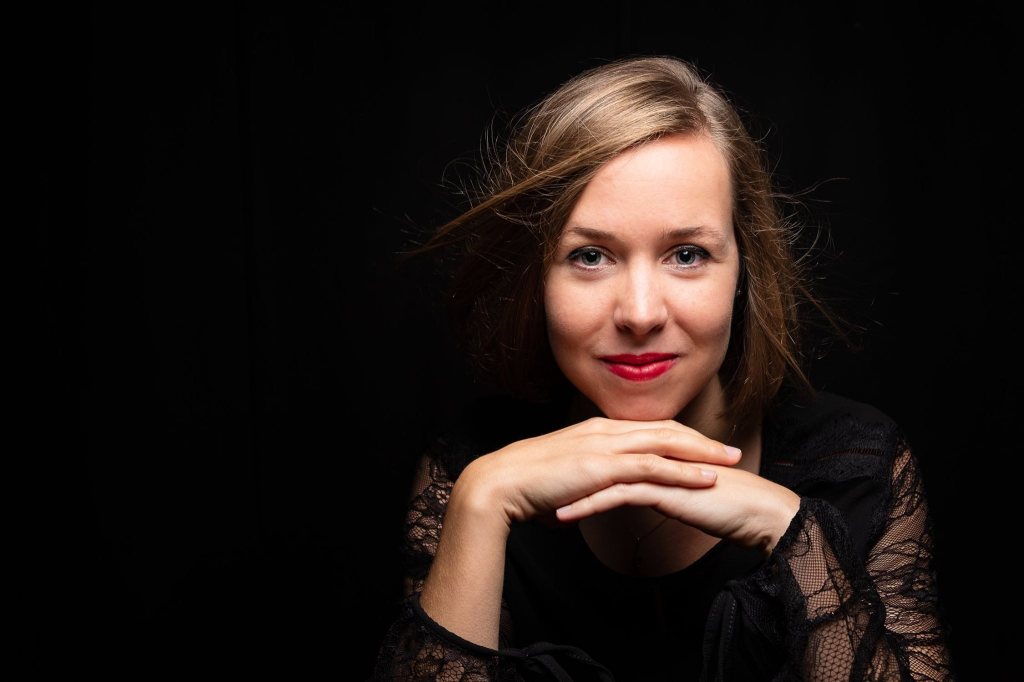
First picture © Anne Bied


Leave a comment