
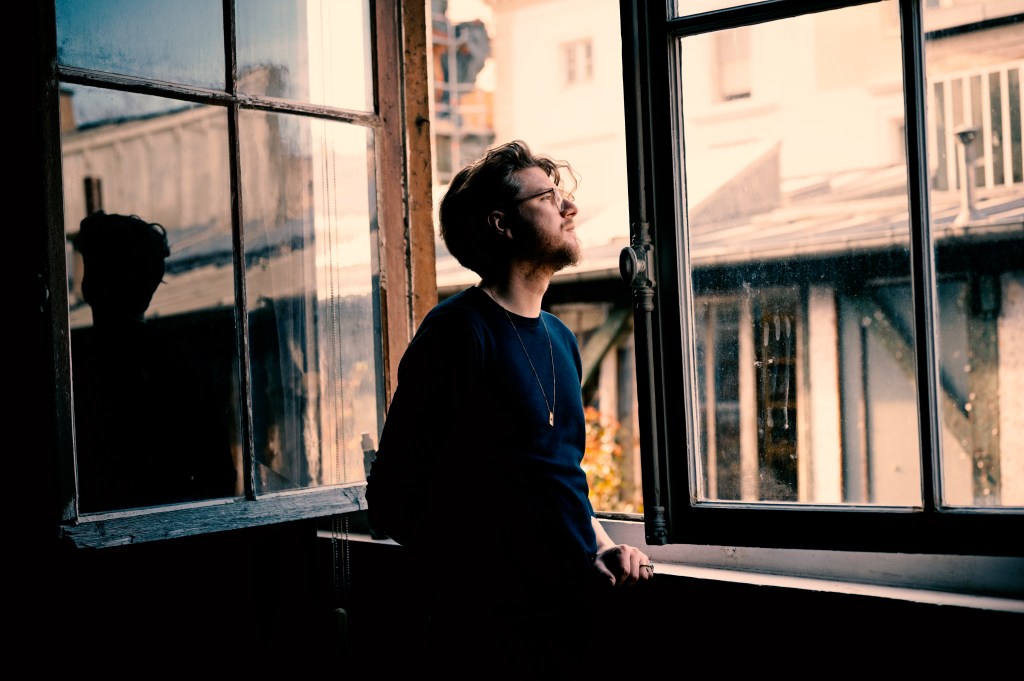
Luna Park: Lux Divina is your second album with your trio. How did this new project come about?
Mark Priore: It’s a very interesting question. Actually, I went through two or three years that were a bit harsh, and the thing that helped me the most during those trying times was music.
I will not obviously go into details, but it was about mourning and separation. At that time I was composing while all of this was happening and it helped me to feel better in some way. One day, I was combing through my compositions, and I thought about Little Thumb‘s fable, and how he uses rocks to remember his path.
To be honest, it was the exact same for me: I think my compositions were like Little Thumb’s rocks: I realized that I was speaking about something that was probably deeper than just my own story.
Maybe it was something more than resilience, maybe it was also about the spiritual light, the divine and those things resulted in the album.
I rearranged the composition I made to create a musical suite that tells the story of someone who has the resilience to keep going and to me, that’s the birth of Lux Divina: following every step of their journey.
L.Park: Throughout the opus, the listener is invited on a musical journey, blending classical, jazz and traditional music. What was your musical guide while creating this album?
M.Priore: Yeah, so it’s a very large question, because I think that the main compositional tool was just sincerity, and even more just being alive. Because I didn’t manage to, I didn’t intend to compose for a certain style of music. For my influences, I think it originated in my childhood, like a lot of other artists, with my parents. They used to listen to a lot of Baroque music, and it made me fell in love with long developments, it gave me an appreciation for something that maybe will not resolve.
Baroque music in its core is about dissonance: the word “Baroque”, means the art of irregularity or singularity. So I interpreted that genre of music as resilience, and trying to make the best of what we have and it found its way in my project. But spiritual music, like Hildegarde de Bingen — a woman composer from the 10th century — has also been a big part of my inspiration, I think it came from Catholic and Protestant music. Arvo Pärt is also a big influence for me.
There’s also the fact that my name “Priore” means “the one who prays”, and I think in my family, there is something about this religion stuff, at least culturally. So I truly think that it was a mixture of all of these experiences and impacts that made the album.
L.Park: Lux Divina could be described as a concept album. Could you tell us a little more about your approach while composing for this project and what it represents to you?
M.Priore: The composition process was about taking everything I had written and try to make it readable for other [laughs]. So I rearranged a lot for my fellow musicians, and the compositions aren’t the same as they were two or three years ago.
Throughout this process, I really tried to unify and propose ideas: it was a safe and freeing place for everybody. It helped a lot with the decisions of cutting or modify certain passages, because one thing that is important to me, is that the album could be replayed. If you take the first notes of the opus, and the last ones, they are meant to form a loop: it’s a personification of resilience, as it’s a constant thing in our lives.
L.Park: So the recording sessions, was it also improvisation? Like you just said, or did you meet before and then you re-record like, how did it happen?
M.Priore: Yeah, we re-recorded the music maybe three weeks before, but two tracks were played before because they are like two or three years old.
So we started to play them in concerts, but it wasn’t on purpose, it was just trying new stuff. But the real vision, the real Lux Divina suite was played the first time three weeks before we got into the studio. It was something crucial because I didn’t want to spend too much time working on it, as it needs to stay fresh. Therefore, recording process was a bit of a journey: there were some tunes that we didn’t practice beforehand.
As you can imagine, our time in the studio was very intense. We stayed like three days, and there was a lot of excitation and fun. At times we even got pretty emotional: music was bringing us closer, and we really felt a deep connection during the recording process. It was a beautiful experience for sure.
L.Park: Why did you choose the trio again?
M.Priore: Very good question. I didn’t choose the trio at first: I was starting to compose on French poetry. At that time, I was working alongside another band, but life happened and we didn’t have the same vision for what we wanted. I guess, for me, it was too early.
As for why I decided on the trio… For me this formation is about freedom, expressing with equity. Everybody has the same amount of place or importance: it’s solid.
L.Park: Going back to the album’s concept, there is the recurrent theme of spirituality. How did you intend to convey this theme through your music?
M.Priore: Yeah, the music itself has some short themes which can be spotted a bit everywhere, sometimes it’s the same theme, just played differently.
We talked about influences earlier, and I forgot to mention a couple of people: Beethoven, Rachmaninoff, Schubert, Couperin and Handel. For me, their music has a lot of resilience in them, and I tried to incorporate their spirituality quality in my music. I would say that Beethoven was one of the most influential spiritual guides, musically speaking. For the repetition of Lux Divina‘s theme — the first and last part of the opus — there’s something more than cadences: it’s really focused on something internal.
So the spiritual mark of the album took a lot from this vision.
L.Park: There is a lot of playfulness throughout the album. How was your approach to composing and recording influenced by your fellow musicians?
M.Priore: I agree with you. I think it happened because of the fellowship we had, and still do. It’s more about the human part, actually: I know that if I played this music with other people, it could be something completely different and maybe less playful.
As for the musical part, the music itself is very heavy: it’s not so easy to get at first. But when we started rehearsing, it felt natural and we were able to bring a lot of life. So even when it’s not easy, we have the tenderness and the need of being playful and joyful.
But yes, in the studio, it went super naturally and to be completely honest with you, we had some trouble with Juan and Élie in the human perspective, because we didn’t meet a lot. It resulted sometimes in disagreements but we always made it alright, as friends first and foremost. But it did make us loose a little bit of connection with each other sometimes. Thankfully, when you have to perform music, it brings you bring us together again, as you have the same mission.
That made us really emotional, because the music helped us to put our differences aside, and that’s such a powerful message.
L.Park: Finally, what was the most challenging aspect during the creation process of Lux Divina?
M.Priore: I would say that there were two main challenges: the first difficult one was to believe in what we were creating. Because this music doesn’t sound like most of the music we can find on the market: it’s a bit hard to pretend to mix baroque with jazz and other influences.
My perspective changed when I was signed with Jazz Eleven: Giovanni was very confident and helpful. But yeah, the first phase was to kind of defend this really fragile project. As you can imagine, it was tough, but eventually we believed in our instincts and we made it happen.
The second challenge was to play the music, not technically, but spiritually. Each tune was a special moment in my life, and to bring them together and making them universal was difficult for sure. My goal is to, I hope, help others, so you have to try to detach yourself from your creations and what they represent.
So overall it wasn’t easy, but I’m very proud of what we were able to create.
First picture © Jean-Baptiste Millot





Leave a Reply