

Luna Park: You began your journey as a musician. How did you end up becoming a conductor?
Jérémie Rhorer: It was during a concert, when I was a young choir singer at the Maîtrise de Radio France that my calling was born.
We were rehearsing the final part, and I had Sir Colin Davis in front of me. He was moving in such a way that I had the impression he was creating the musical waves himself. And that completely fascinated me: it felt like the most beautiful job in the world. That’s when I knew I wanted to become a conductor.
There was also my encounter with Jessye Norman that shaped my decision. I went to Davis’ dressing room to get my program signed, she was there. She was incredibly sweet and was so moved that a child had come like that. She took me in her arms and I truly felt knighted.
It was a crucial experience for me, and from that moment on, the idea of becoming a conductor never left me.
L.Park: As a conductor, what is your first step in interpreting a piece and how does it differ from a musician’s perspective?
J.Rhorer: I always have that sentence of my mentor Thierry Escaich told me: “the ideal conductor is the one that can recreate the piece in real time”. So I work at the piano or at the table to understand the mechanisms of the piece at its core and to make them mine in a way. To extract certain observations, intuitions that will be the basis of my interpretation, but to always be at the service of creation.
L.Park: Which pieces are the most complex to conduct in your opinion?
J.Rhorer: I would say those that are the hardest to grasp in a intellectually and musically.
It happened to me recently with a piece that I conducted twice, Erwartung by Arnold Schoenberg, which was extremely challenging. I struggled to understand the origins of its creation.
And I wasn’t really, how should I say, satisfied with the result. But through hard work, I eventually found a gateway to interpretation. So, yeah, it really felt that this piece was the hardest one I had to work with.
L.Park: Is that difficulty more emotional or theoretical?
J.Rhorer: Both. Some pieces that always inhabited me, so there is a mixture of musical fascination and of a search of what creates magic: in the Beethoven symphony, or in the pieces dedicated to Brahms for example.
In those cases, the analysis helps to understand what you first feel emotionally, and sometimes, physiologically.
It was the case with Ernst Bartholdt, because his pieces can be quite complex, or of course, unknown works. Pieces from my mentor Thierry Escaich that are first unknown to you, are the ones where emotions come to you first.
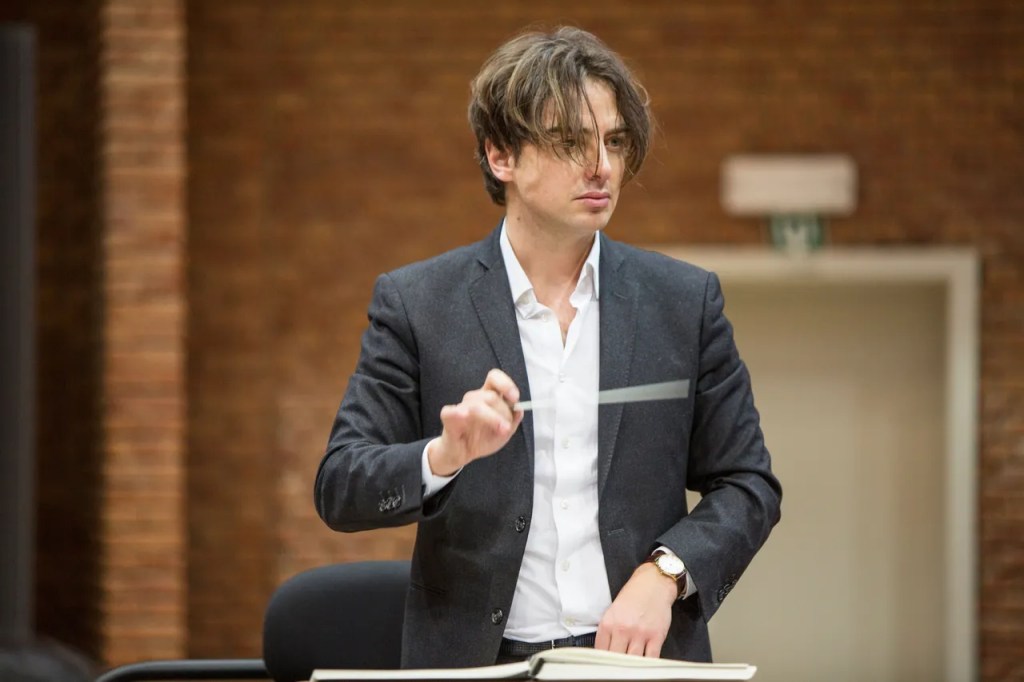
L.Park: Have you worked with contemporary composers when conducting a piece?
J.Rhorer: Yes, especially with Thierry Escaich, who was my composition teacher.
Therefore, I premiered a lot of his works, including two of his operas. It’s such a fascinating work because he’s a composer that I particularly admire.
And I had the incarnation of what I image the vocation of an conducting is, meaning to bring life to a piece. That’s a wonderful work because the composer, in that case, is here to guide you and to insist on the decisions that define the piece.
It’s a rare and precious experience, since most composers are no longer with us.
L.Park: Could you describe your experience in the recording studio? Does it differ from a concert?
J.Rhorer: So, it’s different because we have the same idea as in a concert, but in a certain way, we don’t have the same athletic attitude knowing that we can stop and start all over at any time. Therefore, there is a presence of something less natural. It’s at the same time the security of adjustment and the tension of the time limit.
We shouldn’t underestimate this aspect because I don’t really like the term “performance”.
But there is definitely this aspect of physical performance, at least in a concert, meaning that there’s a sort of balance between the brain and the body that allows us to interpret pieces such as Missa Solemnis or Malher’s Sixth Symphony: those are highly physical experiences.
So you need a preparation both physically and mentally to give justice to your interpretation.
L.Park: How do you prepare for a concert?
J.Rhorer: Always in a similar way: studying the score deeply, its structure, emotions, and the communication of my vision to the musicians.
Not to forget that a concert is also about sharing: you have to imagine that for a musician, at the moment of the concert, it’s a moment of sharing and transcendance. It’s the beauty of interpretation in front of an audience, meaning lots of people which came at the same place to listen to the same thing.
It’s something truly rare in our society: we read a book alone, we mostly go to exhibitions and movies alone or not highly accompanied.
We only find ourselves as a big number with music, where we all listen to the same thing together.
L.Park: As a conductor, do you have the liberty of choosing the programs or are they imposed on you?
J.Rhorer: It depends. With my orchestra Le Cercle de l’Harmonie, we design our programs so we adapt ourselves to certain constraints of our promotors. But always with a rigor and a consistency about the repertoire and the programs we wish to defend.
As a guest conductor, there are more limitations. There was a time where a conductor could choose an opera singer. But now they are imposed on you and it destroys a part of what you wish to transmit. Before, in the musical economical system, like the one of Karajan, the conductor was at the center. Nowadays, it’s the singers and the stage directors that are more highlighted.
It shrinks a lot the choice of prerogatives and interpretations of the conductor, including his first interpretative gesture.

L.Park: You founded in 2005 Le Cercle de l’Harmonie, that you continue to conduct throughout the world. How did the creation of your own ensemble on period instruments changed your artistic vision?
J.Rhorer: The school of thought of Nikolaus Harnoncourt influenced me very early on when I was in the conservatory. Particularly with the full Beethoven album that he recorded in 1989. But what I found fascinating in Harnoncourt is his way of reasoning on several questions at the same time.
I didn’t came to the practice on period instruments by dogmatism: it was precisely by the emotion and the feeling of truth that those recordings gave me (including those of William Christie). It seemed obvious that this music was revived through their conducting. A little like a painting from which we find the original colors back: a burst of incomparable beauty.
So, yeah, I didn’t see it in an intellectual way.
And besides, Harnoncourt resolved a very clear question from the point of view of the composers who weren’t there to guide him. I instantly felt the power of this school of thought and its potential application to other repertoires. And that’s what I do nowadays.
L.Park: The acoustics vary a lot depending on which concert hall you are performing in. How do you adapt yourself with the orchestra?
J.Rhorer: It’s not easy, you have to be flexible and clear with your vision of the interpretation.
At the same time, you have to know what’s impossible and how you need to adapt. It’s really one of the conditions of musical intelligence: to adapt yourself with what you have.
Of course, you are sometimes in places that don’t do justice to your work, and you need to accept it and to make the best out of it.
L.Park: Which artistic encounter marked you the most in your career?
J.Rhorer: There are many artists, masters of thought in all art forms.
If I have one idol, it would be Leonard Bernstein which for me, embodies the ideal musician and understanding of the world. I was trained with his book The Unanswered Question.
In literature, I had a revelation at seventeen years old for The Memoirs of Hadrian by Marguerite Yourcenar, which made me enter into timelessness. A world which was inhabited by the idea of progress that was a little corollary of Marxist historical materialism.
As an individual, I always felt out of place, and I loved how a woman in the 20th century identified herself to a man who lived in another place 2000 years before her. What’s so strong is that what separate them is actually what unites them too.
In the contemporary world, it really became a guide for me.
I also love Albert Camus: in his art, there’s the terrible shock of the First World War that makes it so beautiful and painful at the same time.
On another note, I really love Eugène Delacroix: he represents a moment in the history where art was at the center in France. And that’s special to me: a France known for its art… It’s something that I wish was still the case.
L.Park: Interpretations involve through time. Do you have a piece where your approach completely changed?
J.Rhorer: For me it’s really interesting to answer to that question because every time that I go back to a piece that I conducted them so many times, like Don Giovanni, I continue to learn.
Is it the evolution of the musician? Is it life that makes you see the piece in a different manner?
I would say, in a certain way, each new interpretation is a regeneration stake. I will never conduct in the same way two times in a row, but always in a clear frame. Meaning that the interpretation part is limited to the space left by the composer.
And I truly believe that there are two types of conductors: the ones who are composers and that are capable of creating in real time. And the others, who don’t have the same approach at all.
That creates two different professional ethics.
L.Park: Talking about composition, is it something that interest you?
J.Rhorer: I did compose but not as much as I wished, unfortunately.
As you can imagine, it is highly demanding to have a career as a conductor, an artistic director and a composer. I wrote a lot of pieces, like Le Cimetière des enfants (The Cemetery of the Children) which is a string quartet, first performed by the Orchestre National de France.
I also wrote some chamber music pieces and an opera, that was supposed to be performed but unfortunately, Covid arrived and put a stop to the production.
L.Park: A lot of musicians say that Bach’s music is one of the toughest to interpret. What’s your take on that?
J.Rhorer: Oh no,no,no. Not at all.
I think that there’s a sort of snobbery: Bach’s music flows right away, that’s why he’s the ideal composer.
For me, Bach shows no technical or instrumental difficulties at least, not more than other composers in my opinion.
L.Park: Finally, do you have new projects that you wish to share with us?
J.Rhorer: I have a highly intense season coming up.
I will be present at the Theater an der Wien to conduct Stiffelio by Giuseppe Verdi, and I will tour in Scandinavia with the Dutch Chamber Philharmonic in the spring.
Album wise, I am currently recording La Pathétique of Tchaikovsky with the Dutch Chamber Philharmonic and a collection of Bach pieces with Le Cercle de l’Harmonie.
First picture source: https://www.heuresmusicalesdelessay.com




Leave a comment